Sad as much as we are of missing the outstanding interpreting event of the century (literally speaking!), “100 Years of Conference Interpreting”, in Geneve (3-4 October)?
We have a palliative solution! Below you can find the links to watch the videos of the entire event. Enjoy!
2. Keynote presentation on conference interpreter practice
Prof. Jesús Baigorri Jalón, University of Salamanca, Spain
3. Pecha Kucha presentations on on conference interpreter practice
Jonathan Downie & Graham Turner, Pedro Luis Queiros Duarte & Hugo Filipe dos Reis Cosme, Maya De Wit & Onno Crasborn, Anne Leahy, Maria Mikhailovskaia & Andrei Kalini, Carlo Eugeni & Rocio Bernabé Caro
4. Panel on conference interpreting practice
Prof. Jesus Baigorri Jalon, University of Salamanca, Spain Matthew Ball, Director, Translation Bureau, Canadian Government Juan Carlos Jiménez Marín, Director, DGLINC, European Parliament Uros Peterc, President, Int’lAssoc.of Conference Interpreters Moderator: Barry Slaughter Olsen, Professor, Middlebury Institute of International Studies at Monterey
CONFERENCE INTERPRETING RESEARCH
5. Keynote presentation on conference interpreter research
Prof. Alexis Hervais-Adelman, University of Zurich, Switzerland
6. Pecha Kucha presentations on conference interpreting research
Franz Pöchhacker & Monika Stögerer, Rhona Amos, Yanping Dong, Laura Keller, Laura Babcock & Silvia Fanton & Elisabet Tiselius & Fredrik Ullén, Eléonore Arbona, Yinghui Li & Yanping Dong, Xi Yun Yang, Camille Collard & Bart Defrancq, Koen Plevoets & Bart Defrancq
7. Panel on conference interpreting research
Prof. Alexis Hervais-Adelman, University of Zurich, Switzerland Bart Defrancq, Professor, University of Ghent, Belgium Ebru Diriker, Professor, Bogaziçi University, Turkey Franz Pöchhacker, Professor, University of Vienna Moderator: Kilian G. Seeber, Professor, FTI, University of Geneva
DAY 2:
CONFERENCE INTERPRETING TRAINING
1. Keynote presentation
Prof. Jacolyn Harmer, Middlebury Institute of Int’l Studies, USA
2. Pecha Kucha presentations on conference interpreter training
Marie Diur & Lucia Ruiz Rosendo, Helen Campbell, Carmen Maria Delgado Luchner & Nathalie Loiseau, Marcin Feder, Alicja Okoniewska, Conor Martin, Dirk Verbeke, Joshua Goldsmith Michelle Hof.
3. Panel on conference interpreter training
Prof. Jacolyn Harmer, Middlebury Institute of Int’l Studies, USA Javier Hernandez Saseta, Head, Multilingualism and Interpreter Training Support Unit, DGSCIC, European Commission Ian Newton, Senior Lecturer, FTI, University of GenevaClaudio Fantinuoli, Lecturer, University of Mainz Moderator: Monica Varela García, Chief, Interpretation Service, ILO
Christopher Thiery, Honorary President, AIIC Florika Fink-Hooijer, Director General, DGSCIC, European Commission Agnieszka Walter-Drop, Director General, DGLINC, European Parliament Marie Muttilainen, Director, Interpretation, European Courtof Justice Marie Diur, Chief Interpreter, UNOG Moderators: Jonathan Downie, Alexander Drechsel, Alexander Gansmeier (Troublesome Terps)
In the last post we talked about the challenges in remote conference interpreting, especially focusing on simultaneous interpreting. Today, instead, I’d like to focus on remote consecutive interpreting, more in particular considering the over-the-phone modality.
Apart from onsite interpreting jobs (95% of the cases for me), more and more often in the last 3-4 years I have provided over-the-phone remote consecutive interpreting services for a US consulting company. It is for small meetings of only two people in general, in which a consultant or an investor from a country contacts an “expert” of the field based in another country, to carry out a market studies or tackle financial enquiries.
I actually started working with this US consulting company for onsite services, with the first meeting in Madrid between an Australian investment group (coming to Madrid all the way from the land down under) and a local expert.
Advantages of over-the-phone consecutive interpreting
Without generalising, I have to say that for this kind of meetings and for my specific circumstances and logistics, I find the remote service much better than the onsite meetings. Since they are never going to take place in Alicante (where I am based), doing it over the phone saves me all the travelling organisation, travelling time, and the client doesn’t have to pay for travelling costs.
Everything goes through an efficient and automatised platform, so I don’t have to send a quote each time (as I would for onsite assignments, always requesting an upfront payment): they already have my fees on their database; they send me an invitation; I accept it indicating my availability; the meeting is confirmed, and at the end of the call I automatically receive the payment.
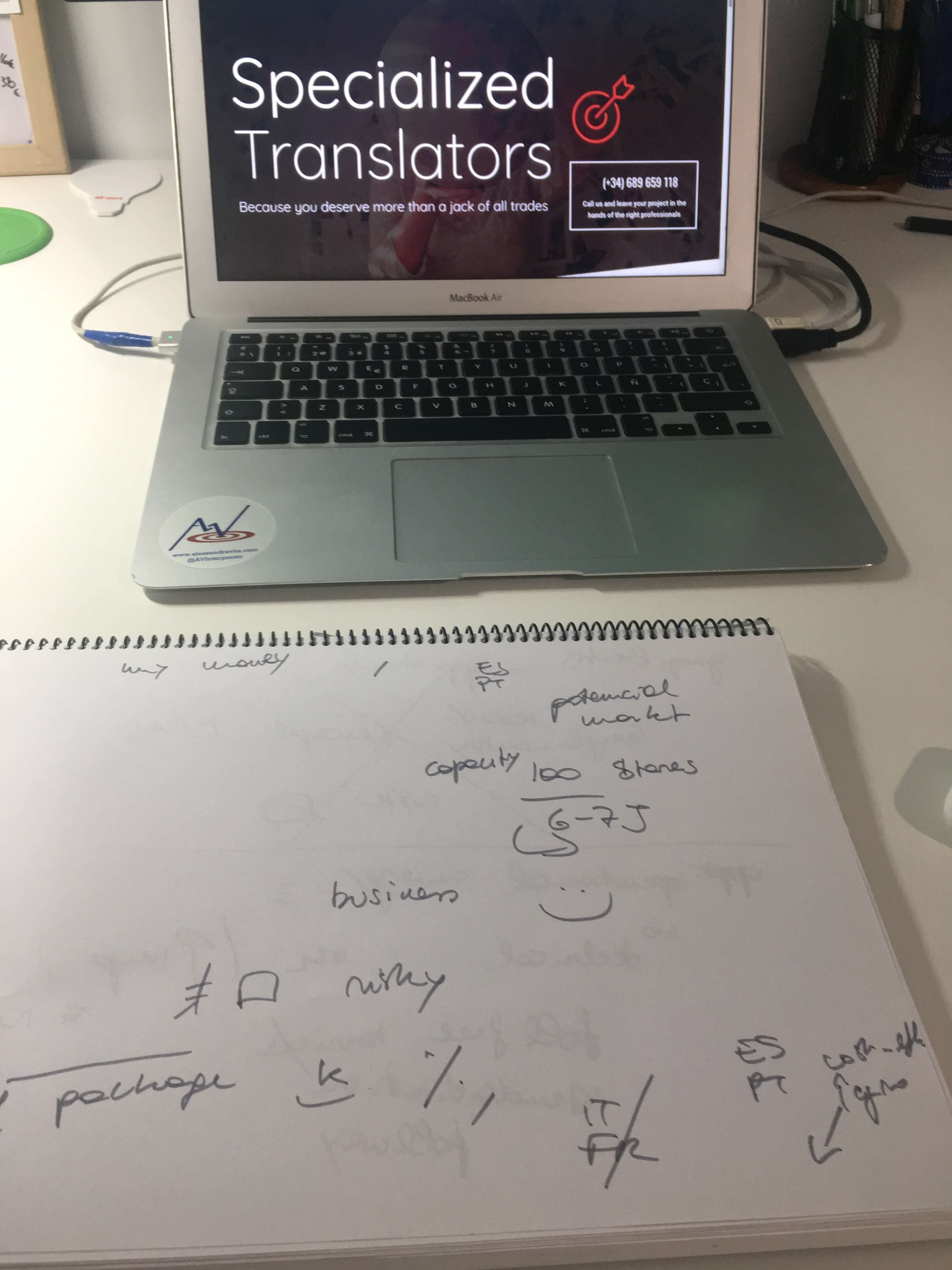
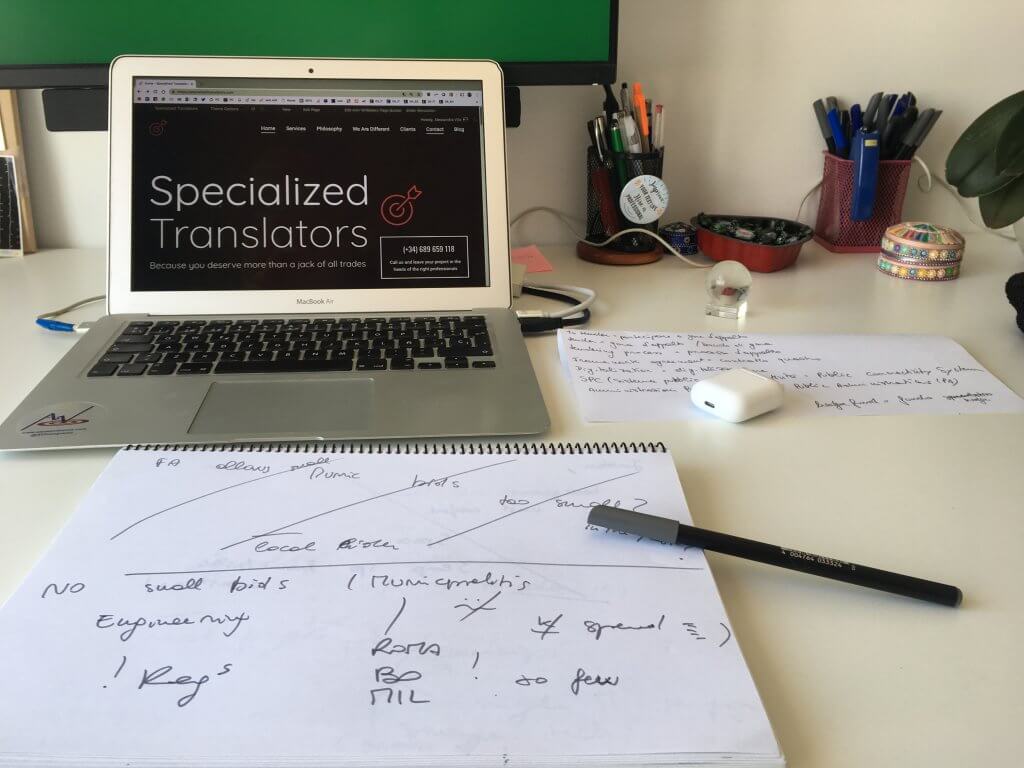
I would be alone anyway in this kind of consecutive assignments, so the booth mate is not an issue here. I don’t have to fear potential issues with my Internet connection, either. It’s a simple call without video, so I can wear my AirPods (which I am deeply in love with). I comfortably take notes with a big, handy notepad on my desk (I don’t have to hold it in a very elegant yet uncomfortable way as in a face-to-face situation). Plus, I can fill my desk with all the glossary sheets and notes I want. Also, another good advantage is being able to look up anything on the Internet, if I need, without anybody noticing a thing.
Again, it’s a very specific type of meetings, where the non-verbal component plays almost no role, in my experience.
Disadvantages of over-the-phone consecutive interpreting
The only slightly-tricky part might be voice overlapping (e.g. the expert makes a pause and I start interpreting believing he’s done, but then he wants to add something else he just remembered). Yet, this is far from a big issue; I would simply say, “Sure, go on”, and problem solved.
Furthermore, exactly as in onsite meetings, some speakers want to talk for ages, leaving the other person having no clue of what is being said for 20 minutes, and that’s when you should try to delicately set the timings to avoid the listener’s frustration.
In other words, I do exactly the same I would do onsite, but more comfortably; I apply the same economic conditions, and lose no time travelling (and, as they say, time is money); plus, the client doesn’t have to pay for travelling costs. In this very specific case, I think that it’s definitely a win-win situation for everybody involved.
A very different story is remote conferencing interpreting for big events. If you missed it, have a look at the previous post about the challenges in remote conference interpreting, where AIIC guidelines on remote interpreting are also mentioned.
As always, if you’d like to share your experience and insights, you’re more than welcome to do so on the comments below. Thanks and see you soon!
Remote interpreting is here to stay, whether we like it or not. Exactly the same happens in translation with machine translation (MT) and post-editing. Technology is disrupting every industry, not only ours. Yet, we don’t expect them to become a one-size-fits-all solution any time soon, meaning that neither every type of document will be translated with MT and then post-edited, nor will all interpreting assignments be provided remotely, and that is for very good reasons.
New and fear go often hand-in-hand, but in general there always some pros and cons in every change. For several years I have been providing over-the-phone consecutive interpreting for a client, and based on my experience it has great advantages, as I will mention in the next post. Yet, when it comes to remote conference interpreting for a big event, it’s a different kind of story and I think there are still challenges we need to overcome for it to be a viable option.
This is the service I am most skeptical about providing remotely (in fact, I still don’t). The reasons are mainly three:
[dt_gap height=”20″ /]
Technology
Right now, I don’t trust technology that much to feel comfortable interpreting from my office. That would imply trusting, on the one hand, that my Internet connection will cooperate smoothly and, on the other, that there won’t be any audio and video-related issue (since the AV technician won’t be physically there to solve it).
[dt_gap height=”20″ /]
Money
So far the only agencies with remote-interpreting platforms that have contacted me for this kind of services tried to impose me a rate per minute (in general €1 per minute) of actual interpreting, which is absurd and far from acceptable. That means, for example, that if the event starts 30 minutes late I am not paid for that time I have been sitting in front of the screen just waiting, nor will I get a cent during coffee breaks or lunch. Plus, what if the conference lasts for only 40 minutes instead of all day? Will I be paid €40? How can all the preparation be cost-effective then?
For all the above, when receiving that amazing offer, I replied that I was willing to give it a try, but applying my standard fees as if it were a standard onsite conference (charging from the minute I am requested to be there, till the moment I switch off the microphone at the end of the day, but not per minute!). The end client could still save on travelling costs, and since I have to travel 99% of the times from an assignment to the other, I would be more than happy myself to reduce some travelling, but only if good working conditions are safeguarded.
I believe it’s too late to expect that everybody could charge decent fees and apply top conditions for onsite assignments, but hopefully we still have time to prevent bad practices from becoming common.
[dt_gap height=”20″ /]
Booth mate
Simultaneous interpreting is a team effort, every professional interpreter knows it. It’s not just a matter of turns, of you doing your 30 minutes and then handing the microphone over to your colleague so that your brain can recover. Being physically next to your colleagues allows you to communicate with them even non-verbally: you may just look at them during your turn to implicitely ask them if they got the last idea, figure, name or to tell them that it would be a good time to change.
As far as I know, most online platforms currently available in Europe request you to talk with your colleague through a chat, which is far from ideal in my opinion. It’s an additional task that can distract rather than help us. If I were physically with my booth mate in a standard booth, just with a look, the colleague would know if I need help with a term and exactly which one. Via a chat, either colleagues write down everything just in case (which I would find distracting) or I would have to type what I’d need from them. Instead of doing that, I might as well just look it up myself.
For the same reason, according to AIIC guidelines on remote interpreting, both partners should be interpreting together from the same physical location.
[dt_gap height=”20″ /]
A viable remote-interpreting solution in the US
Image courtesy of KUDO.
The best solution I have heard of so far is KUDO, a US company allowing you to go to an interpreting studio in the main US cities, such as NYC or Chicago; there you would have a standard ISO booth, which you would share physically with your booth mate, and you would follow the conference via a screen. Plus, you would be able to rely on the support of an AV technician taking care of any technical issue for you.
I find this a good solution for a big country like the US, where distances are huge. Yet, personally, I don’t think it is likely to work well in Europe: if they set an interpreting studio in Madrid or London, I might as well just go onsite to the conference, with travelling costs being the same. The only advantage would probably be the chance to provide interpreting services in different time zones (e.g. in the European case, for Asia and the US).
[dt_gap height=”20″ /]
The remote-interpreting debate is definitely still work in progress, so I reserve the right to change my mind based on new evidence and experience gained in this field.
And you? What do you think about it? Do you already provide remote conference-interpreting services? Which platforms or systems do you use? How has your experience been so far? Leave a comment below. 🙂
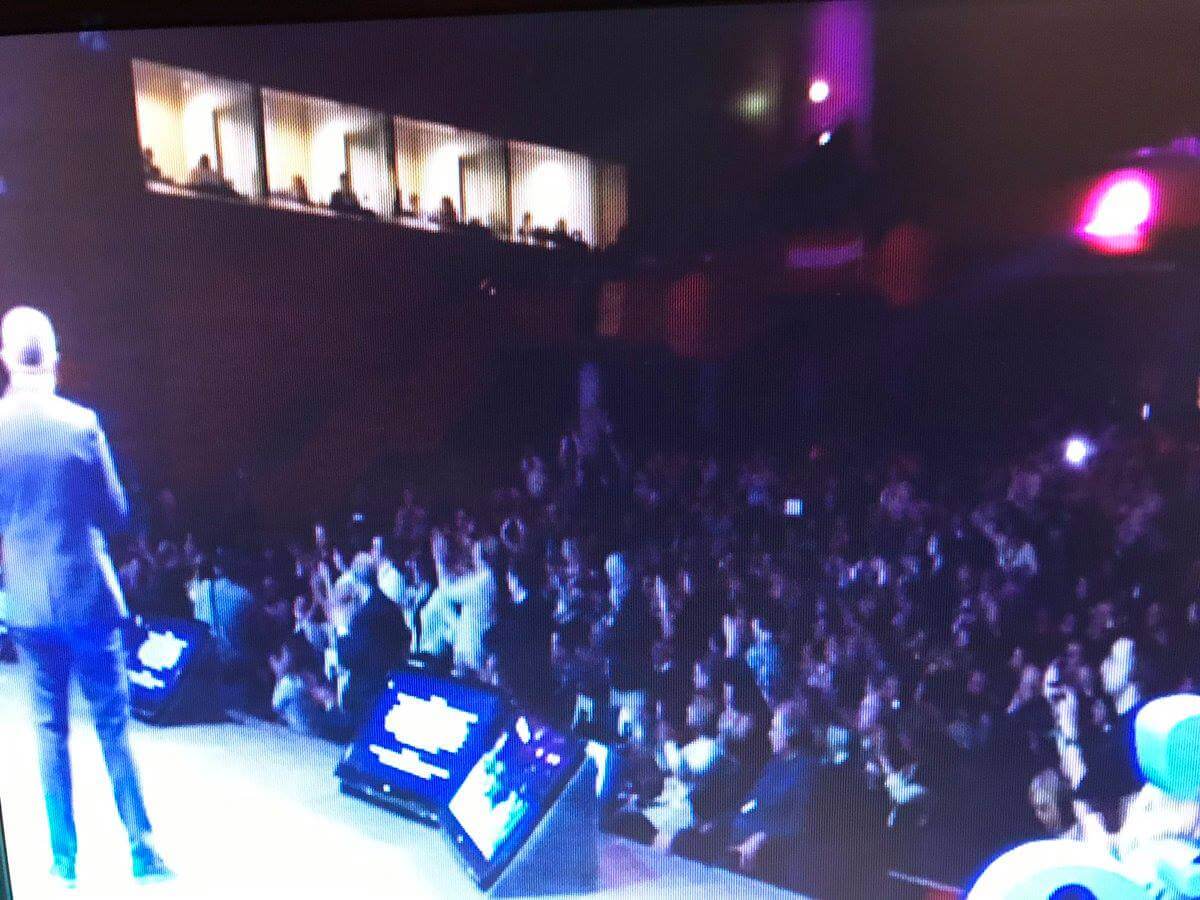
In the past few days we have been busy interpreting at the best multilingual conference ever. With attendees from all over the world and 12 amazing interpreters divided in six booths (English/Spanish, French, German, Italian, Portuguese, and Russian), this has been the best example of a multilingual conference we have seen so far.
Not even the EU is so multilingual: interpreters of all EU languages might be there ready to do their job, but unfortunately many speakers still decide to speak in English rather than in their mother tongue, leaving the English booth’s microphone off most of the time. In our opinion, this makes their message weaker, less assertive, with potential negative consequences on what they wanted to accomplish with it.
This case, instead, was simply amazing. Each and every person on stage spoke in their mother tongue, even when interacting with people of a different language. The event was taking place in two different auditoriums at the same venue, with more than 2,000 attendees in total.
Some sessions were held by two different hosts talking to each other, one in each auditorium. Most of the times, it was a Spanish-speaking host talking with an English-speaking colleague. This of course was piece of cake for us Spain-based interpreters, all with English and Spanish in our language combination, because each person of every booth could interpret alone this dialogue.
The most complex situation for us interpreters, though, was another session in which a French-speaking person was talking with his German-speaking colleague, again in the other auditorium. The only booth who had both languages covered was ours, the Italian booth, since I could interpret directly from German into Italian, whereas my colleague from French into Italian. We just had to be quicker than normal to keep about the same timing as the original dialogue, but it wasn’t complicated for us.
In the remaining five booths, though, our colleagues had to use what is called relay interpreting, i.e. using a colleague’s interpretation as the source message to be interpreted into their native language. For example, during this French-German session, our Russian colleagues (who had English, Spanish and Russian in their language combination) had to rely on the relay of both the German interpreter and the French one into Spanish, which they then rendered into Russian.
The tricky part is due to the delay. Even if it is called simultaneous interpreting, there is always a slight delay (in general, a couple of seconds) between us and the speaker, so that we have the time to process the information and offer it back in the target language. In this case the delay was double (from French/German to Spanish and then from Spanish to Russian); plus, the speakers were two with short parts each, which meant it all had to be very quick.
Again, the organisation of this event was superb. They provided in advance the scripts of the sessions and scheduled several rehearsals, where we could check whether we had enough time to do it with relay. As they say, practice makes perfect, and everything went great.
So the next time you organise a multilingual event, think about this great example, deliver your message as strongly as possible in your native language, and let us interpreters do the rest!
Lately, interpreters have been all but invisible on the news, especially thanks to US President, Donald Trump. The latest case you may have already heard of regards the secret bilateral meeting between Trump and Putin, with the help of an interpreter. Due to its secrecy, in the US there is currently a significant debate on whether the interpreter and/or her notes should be subpoenaed to shed light on what was said during the event.
We would like to share today our merely-professional standpoint on the matter providing 3 reasons why the interpreter should not be subpoenaed.
1. It is against interpreters’ code of ethics to breach confidentiality
The main pillar of interpreters’ work is the utmost confidentiality of everything that is said during the interpreting service. It is not a coincidence that every interpreting association includes it in its code of ethics. This allows every person involved, whether it is a business man during a commercial talk or a politician attending a high-level bilateral meeting as in this case, to speak freely. Confidentiality is key also in other professions, such as for lawyers, priests, journalists, and many more.
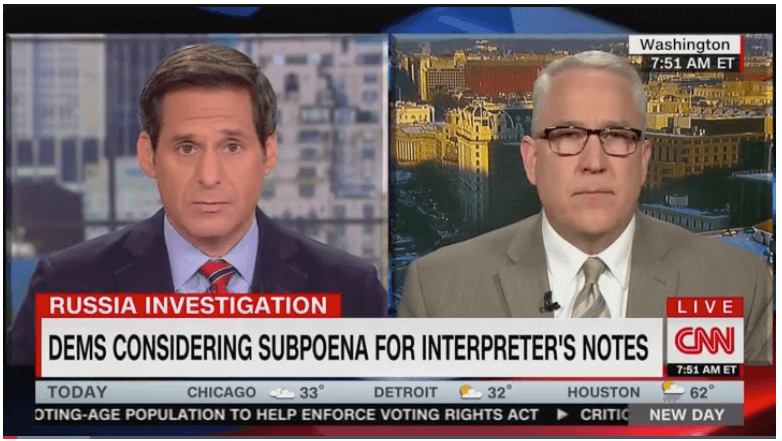
Interpreters are there just to let the communication flow, not to be used as spies or transcribers nor to judge. They should never be asked to breach confidentiality or, as our colleague Barry Olsen rightly states in an interview with the CNN (see below), there will be serious consequences in the long run for diplomacy and trust in interpreters in general.
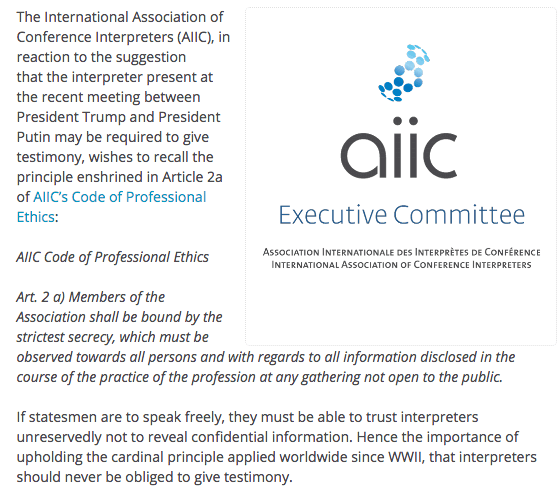
Below follows the statement issued by AIIC (International Association of Conference Interpreters) on this issue.
2. The interpreter won’t be a reliable witness anyway
Even if neglecting the consequences of breaching confidentiality, the interpreter won’t be a reliable witness anyway. That is because we interpreters are terrible at remembering with enough precision what we interpreted even shortly before. When we work both consecutively (as in bilateral meetings) and simultaneously (from a booth, talking at the same time as the speaker) we store information in our short-term memory. Once we have interpreted a piece of information, it is quickly and efficiently deleted to make room for more.
3. Subpoenaing the interpreter’s notes will be completely useless
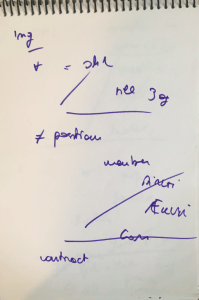
Example of my interpreting notes, with a good deal of “doctor-style” handwriting.
In order to be able to accurately convey what has been said during a bilateral meeting of this sort we interpreters take notes, which are more similar to hieroglyphics than what people might understand when hearing the term “notes”.
As you can understand by looking at the picture of my interpreting notes, not only will it be impossible for whoever subpoenas those notes to decipher them, but the interpreter won’t be able to remember what they meant either. In my case, after months, I have no clue of even which assignment they were taken for.
As a matter of fact, interpreting notes are not to be confused with shorthand or any other standardized system to transcribe contents accurately. Rather, they are merely a visual and personally-developed mnemonic help with a very quick expiration time (about 15-30 minutes).
Completely in line with our considerations is the very exhaustive contribution of our colleague, Barry Olsen, who was interviewed by the CNN on this matter. To watch the interview, click on the image below and then scroll down to watch the last video of the page. Enjoy it!
If you want to share your opinion on the matter, add further arguments in favour or against subpoenaing the interpreter, we’ll be glad to read your comments. Thanks in advance!
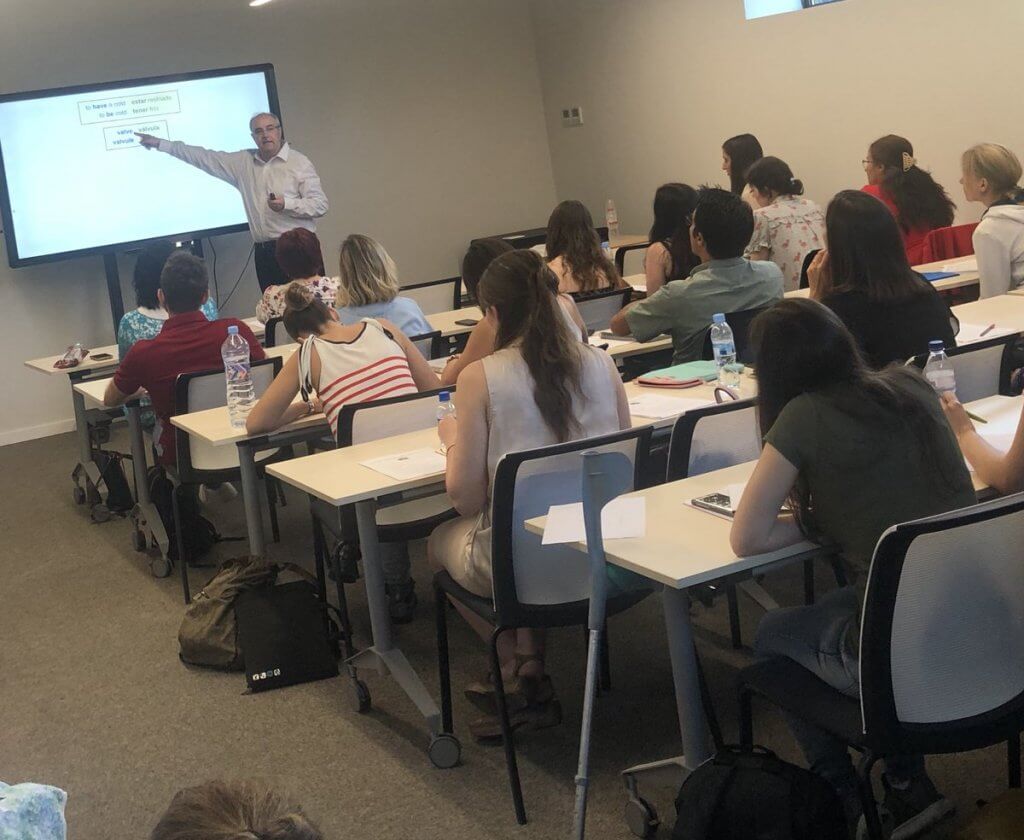
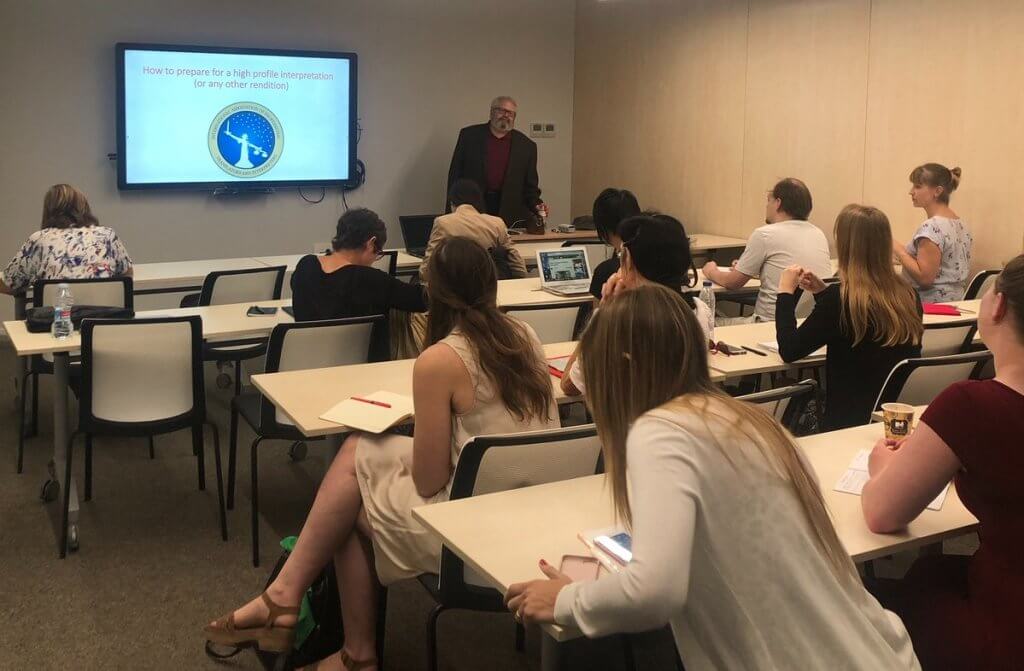
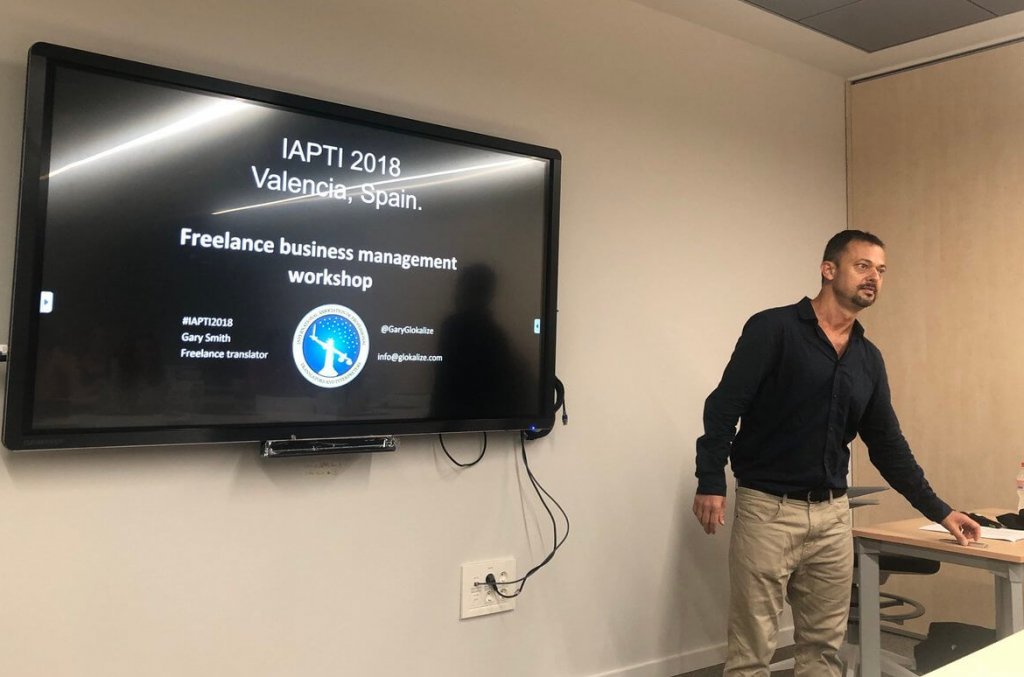
Additionally, three IAPTI workshops were offered at Universidad Europea de Valencia on Friday 28th: an English-into-Spanish medical workshop by the number one of the field in Spain, Fernando Navarro; a business-oriented workshop by one of IAPTI’s great organisers, Gary Smith; and, last but not least, a third workshop on how to prepare for a high-profile interpreting assignment by the one and only Tony Rosado.
Fernando Navarro’s workshop on medical translation
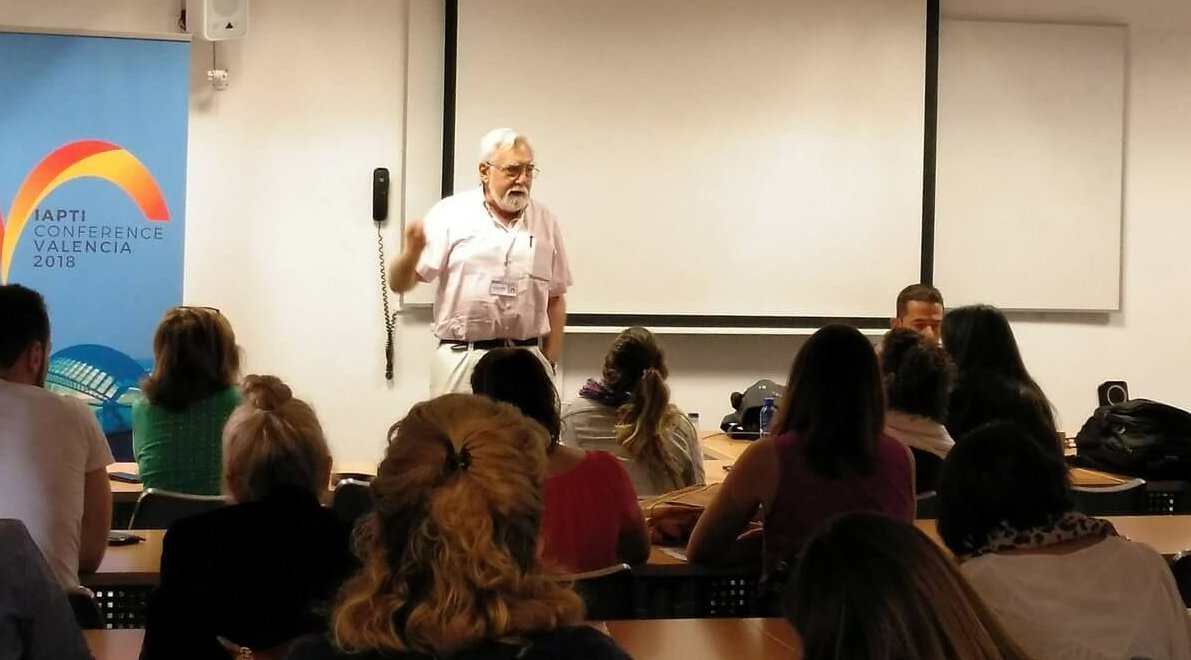
Tony Rosado’s workshop on high-profile interpreting assignments
Gary Smith’s workshop on freelance business management
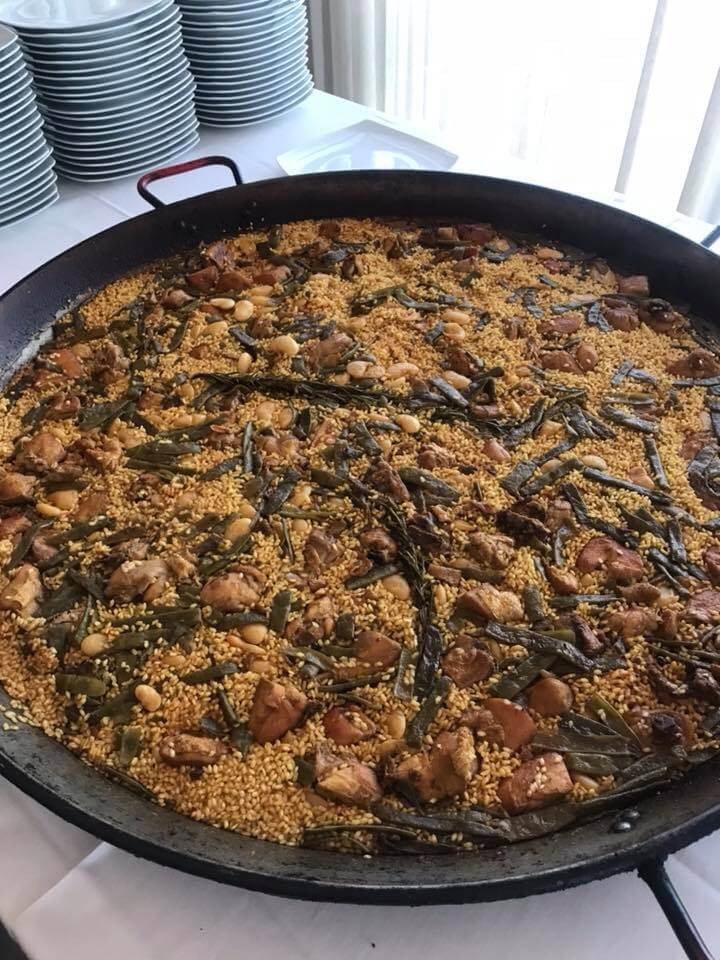
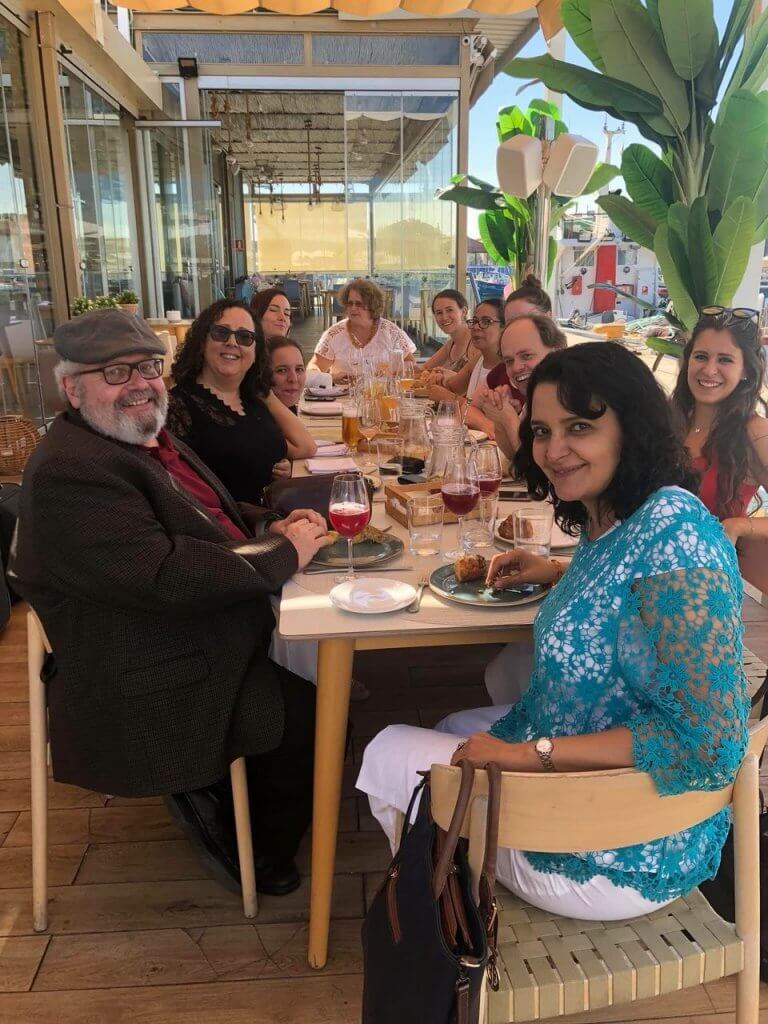
Once the workshops were over, some of us had lunch at a very nice restaurant by the port. Those coming from far away could already have a taste of the Spanish life, also timewise: we started eating at 3 pm and finished by 6 pm our sobremesa (when you’re done eating but remain at the restaurant talking).
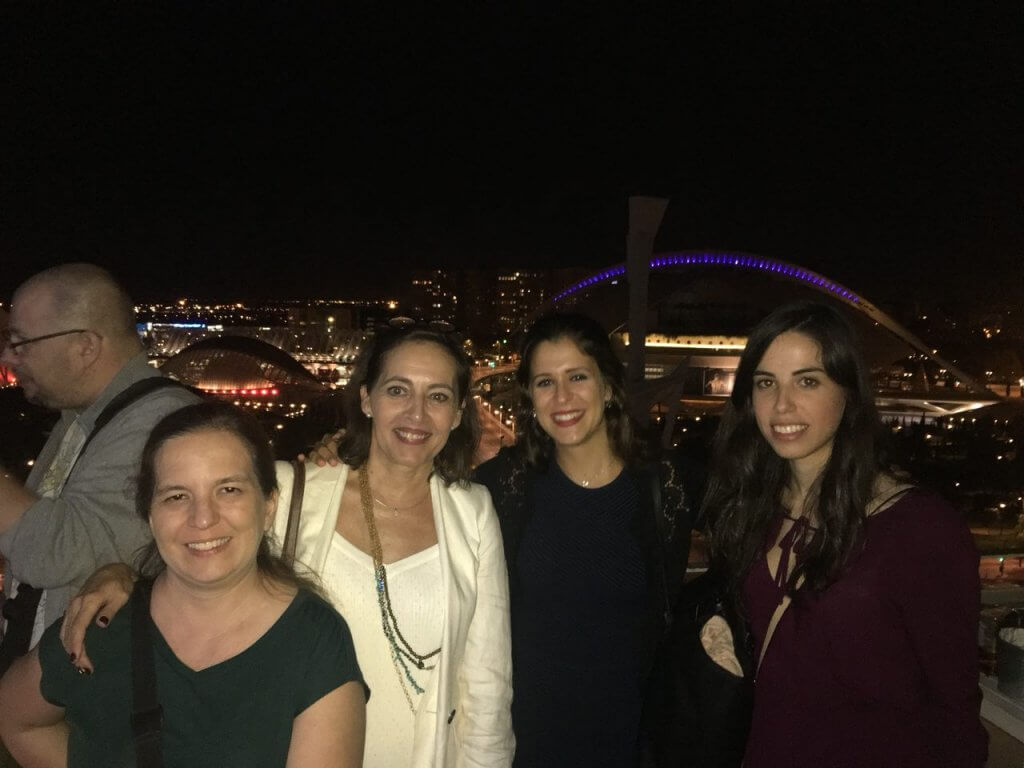
Shortly after, a cocktail dinner was waiting for us at Hotel Barceló, with one of the most exclusive views of the City of Arts and Sciences.
Saturday
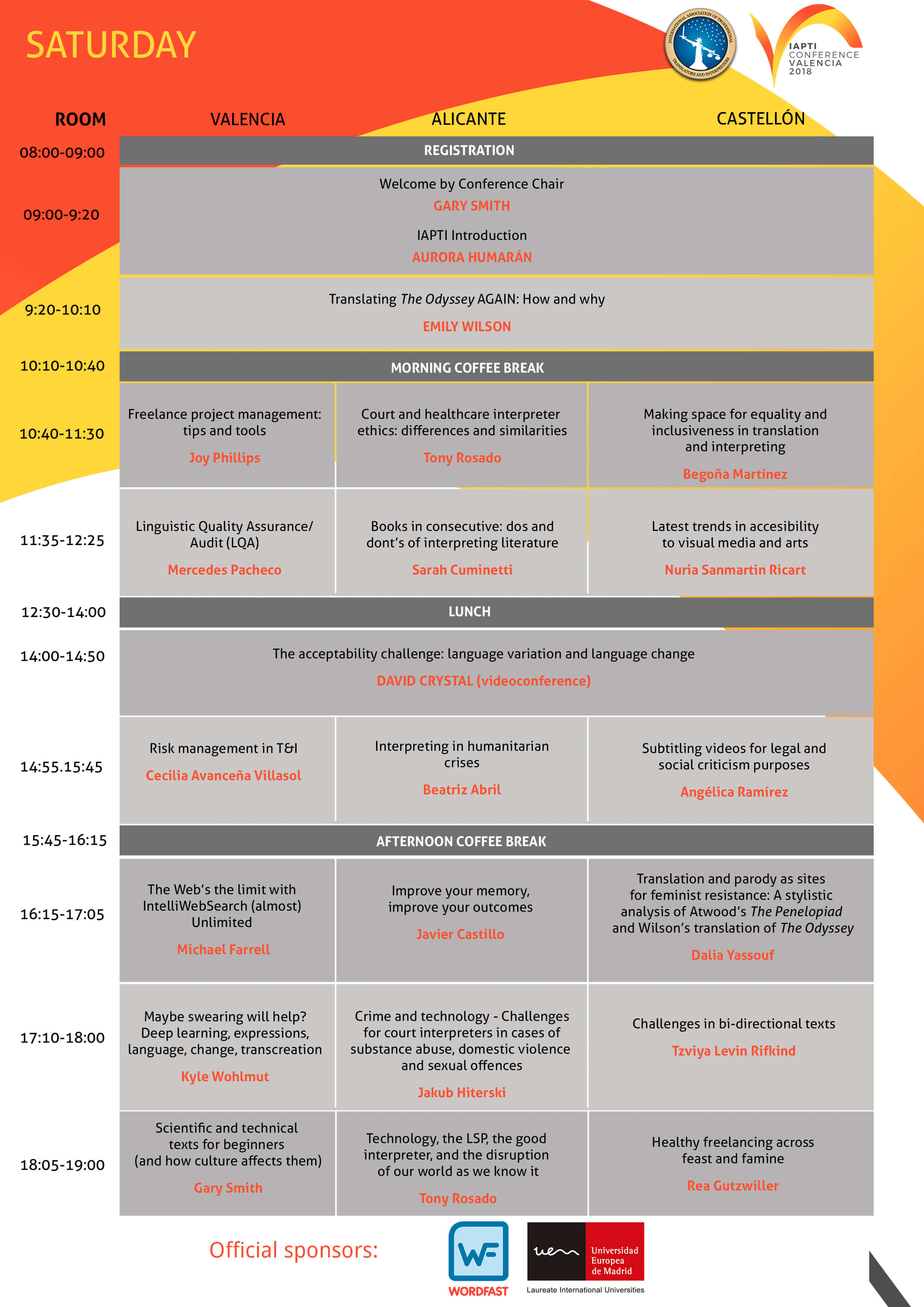
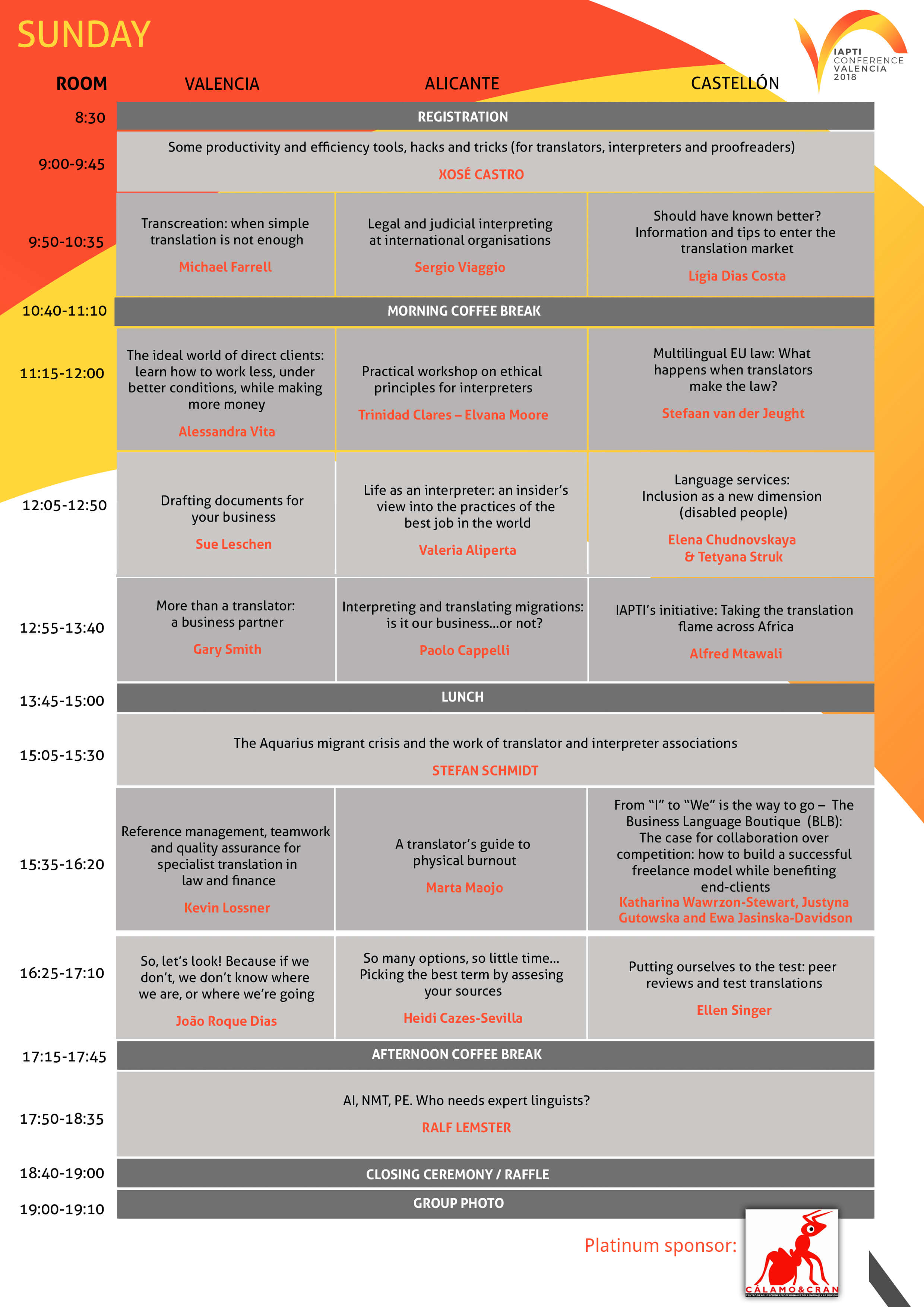
If you look at Saturday and then Sunday’s IAPTI programme, you might understand why ubiquity would have come in handy at this conference. There were too many interesting talks taking place at the same time, so it was extremely hard to choose just one.
After the great opening by Gary Smith and IAPTI’s president, Aurora Humarán, the first presentation was delivered by the first keynote speaker, Emily Wilson, who re-traslated the Odyssey into English. She dived into this challenging adventure to try to be more loyal to the original and convey the possible different interpretations it offered. Curiously, media coverage mainly focused on the fact that it was a woman who now translated it, even though many female translators had already done the same into different languages before her.
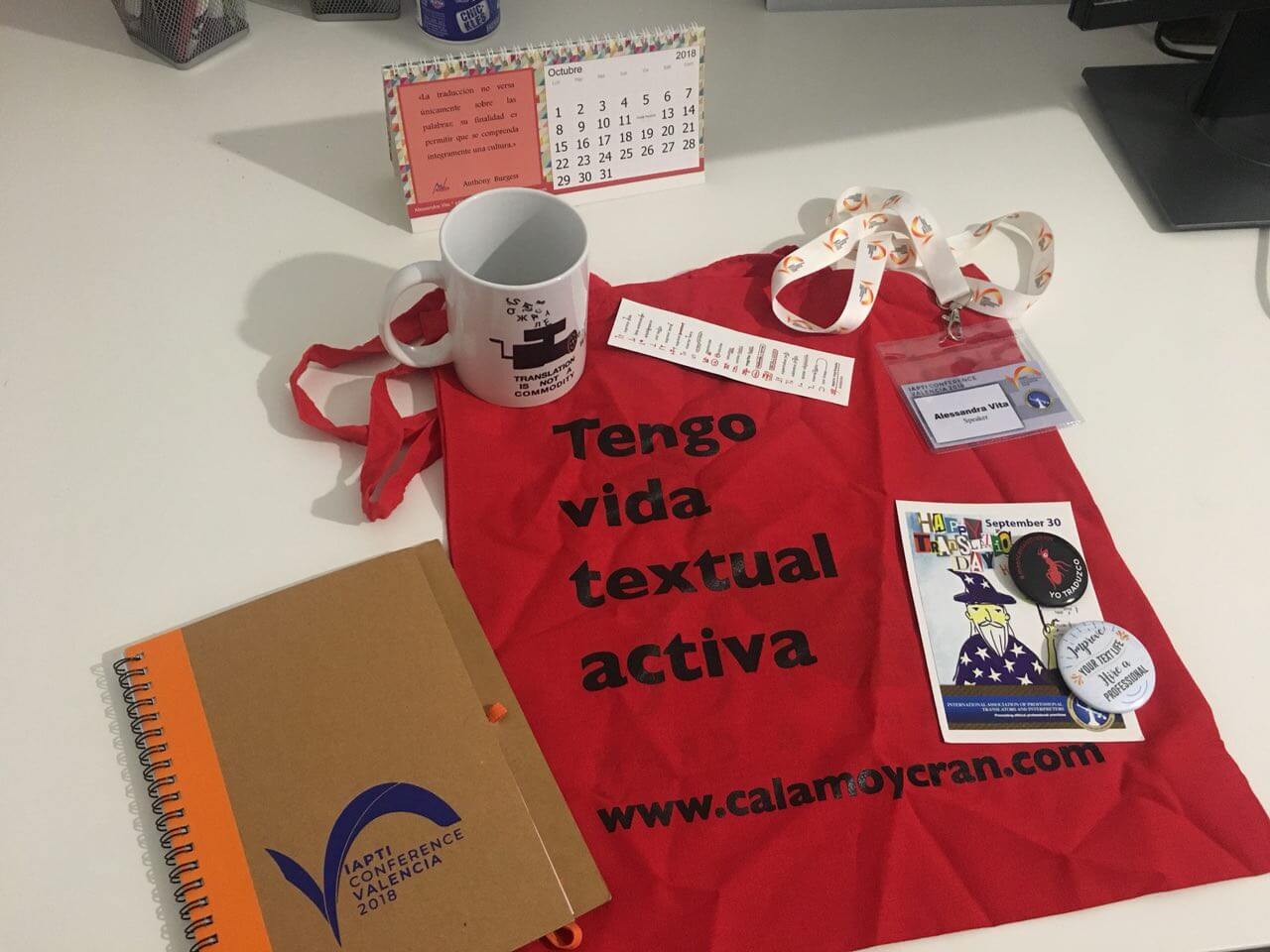
Since ubiquity wasn’t unfortunately included in the lovely IAPTI welcome bag, you can only find here a summary of the talks we attended.
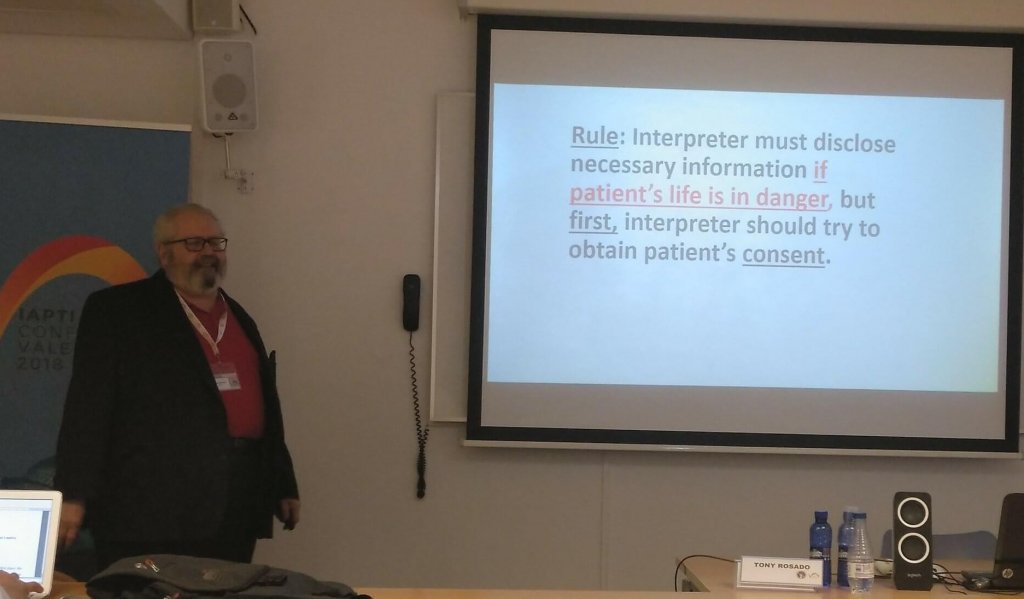
Tony Rosado spoke of court and healthcare interpreter ethics, where we considered, among other aspects, interesting ethical dilemmas regarding confidentiality. For example, can you reveal a piece of information you got in a previous interpreting session if the patient is in a coma and his life depends on it? Tony underlined that your goal as a healthcare interpreter is the patients’ wellbeing, but you should always get their consent first if possible. In a healthcare situation, you need to interpret everything, and warn everyone of it; they can’t tell you, “Don’t say to him that…”. Also, you should try to persuade patients to tell the truth, unlike what happens in court interpreting. In the latter, Tony explained that duty of confidentiality ends by court order; not even a priest is exempt, only the legal team (including the court interpreter) thanks to the client-attorney privilege.
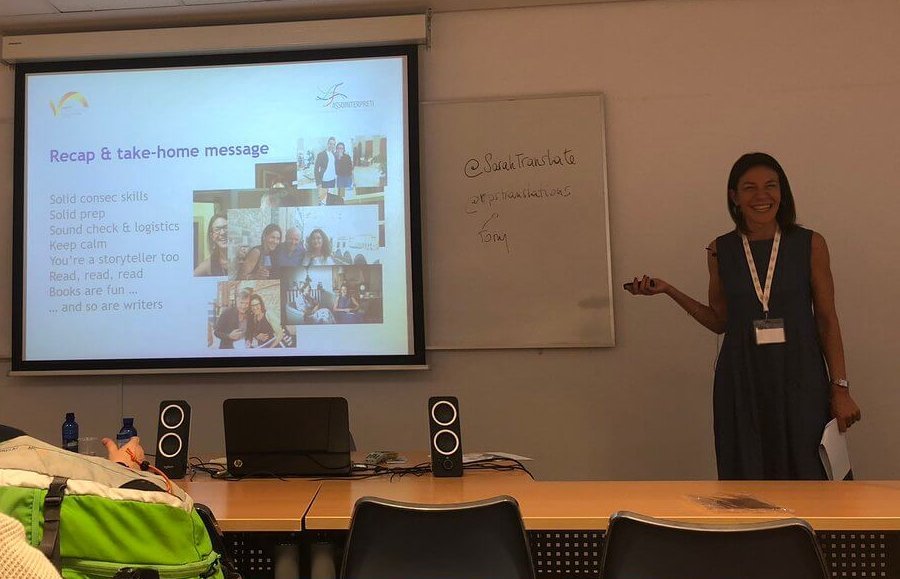
After Tony, many interpreters had the pleasure to attend Sarah Cuminetti’s presentation about her interpreting experience related to books. She explained that most of the times you need to offer consecutive or whispered interpreting in such settings. Ideally, you should read the book in question, but that’s not always possible due to last-minute requests. In that case you need to prioritise and focus on the authors’ biography and main titles published (of which you should know the translation). It’s also key to try to find out their favourite writers and books since this is a common question asked by journalists. Other than these, Sarah clarified it won’t be possible to know all the writers and book titles of the world in two languages, and that there will be surely someone in the room that catches the reference, so don’t make titles up yourself!
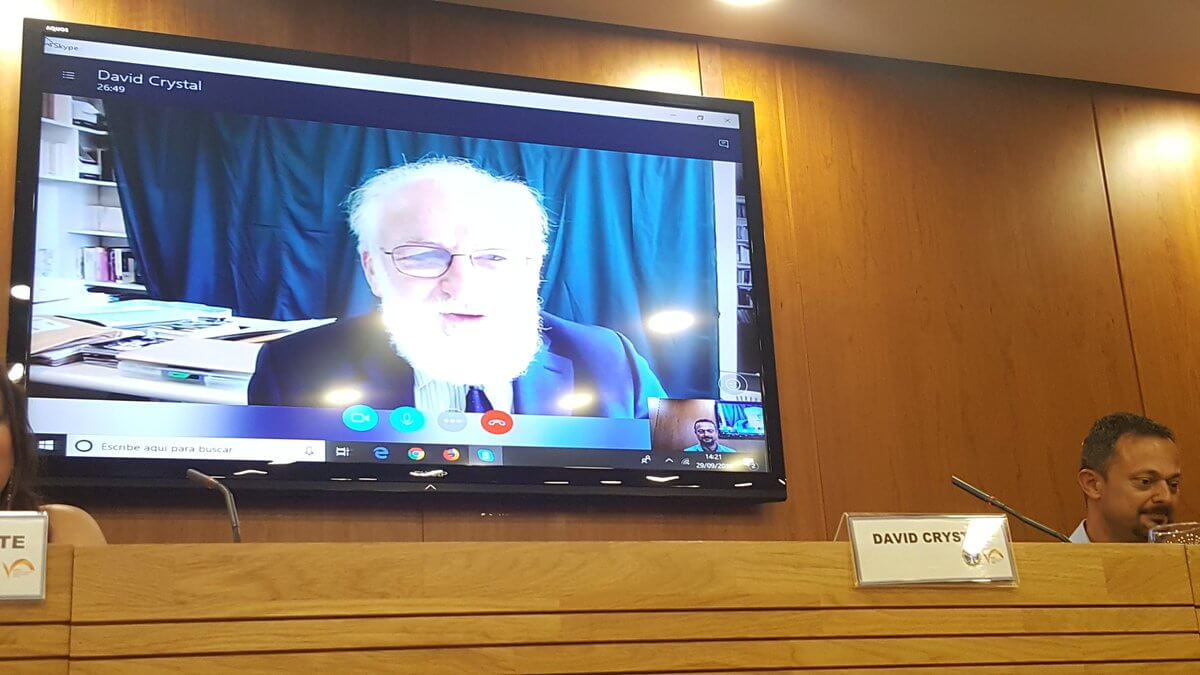
After a delicious lunch, technology offered us the very insightful talk of Prof. David Crystal who spoke about language acceptability and change, with a great deal of humour. He explained that there are many English varieties: written and oral English; formal and informal English; in-house (for peer experts) and out-of-house (for general audience) English. Furthermore, translations can be either synchronic (as language is now) or diachronic (with history of language use over time). As translators, we might therefore face the dilemma of whether we should keep on translating concepts or terms as we used to in the past for consistency or rather based on the current needs. Prof. Crystal also underlined that it’s completely normal that language changes (e.g., ‘must’ has been substituted more and more by ‘have to’ in the last decades), and that the only ones that don’t change are dead languages.
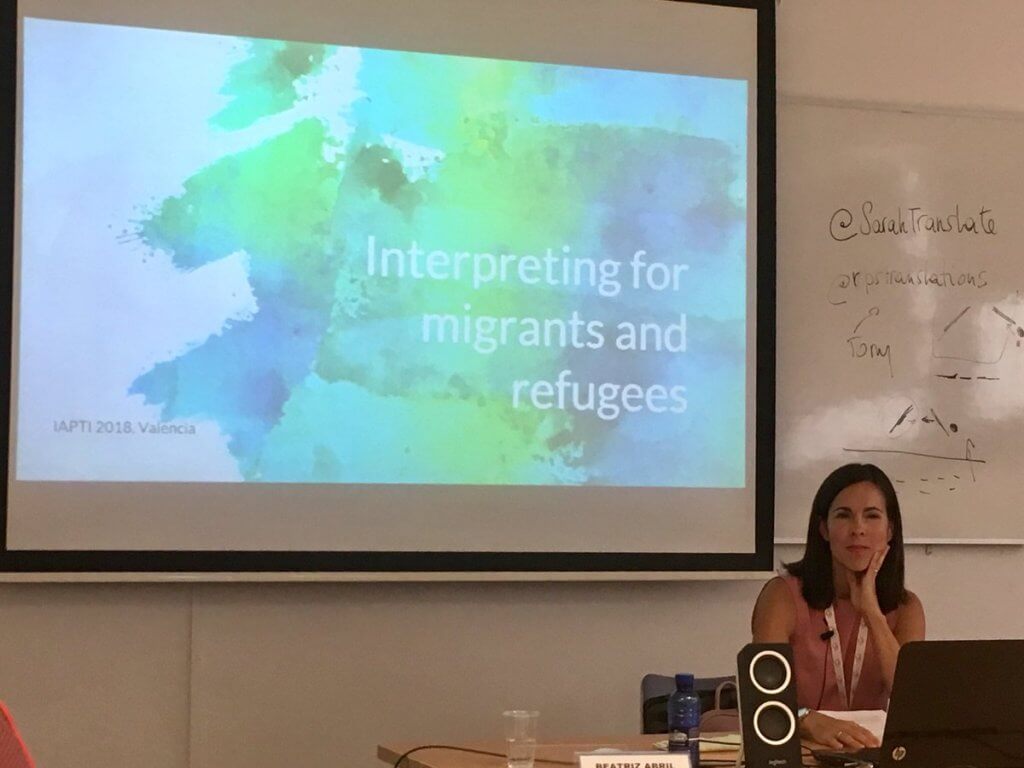
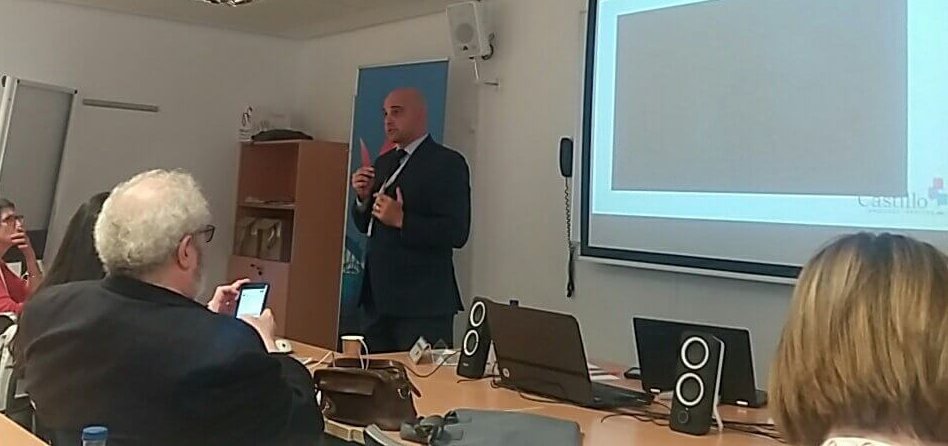
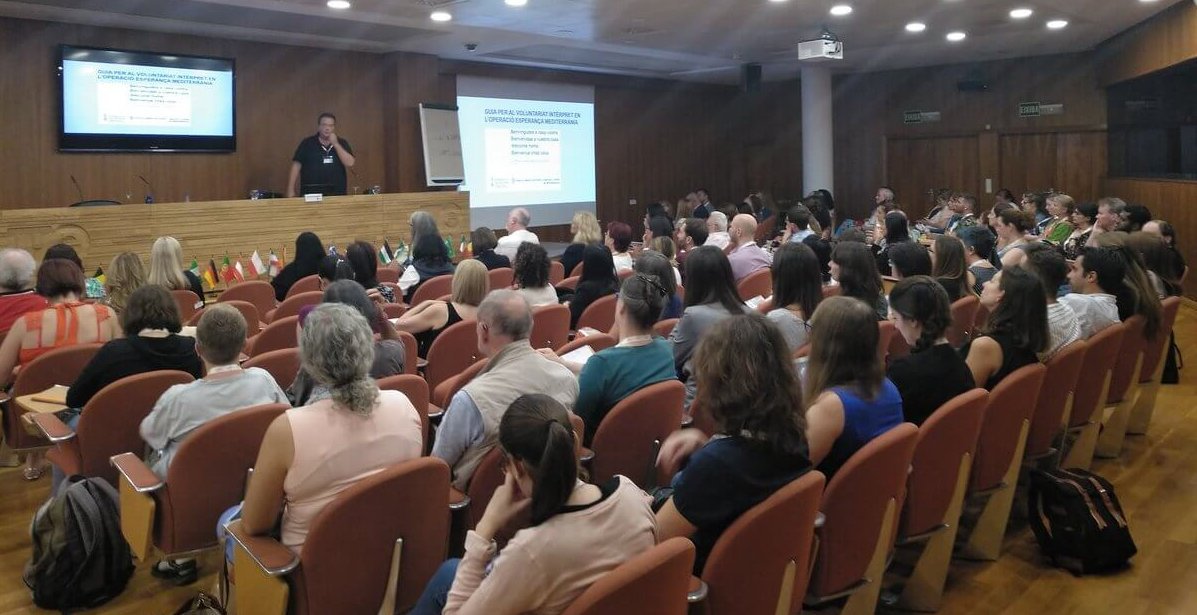
Then, back to the interpreters’ room to listen to Beatriz Abril on interpreting for migrants and refugees, followed by Javier Castillo‘s workshop on how to improve our interpreting skills using memory palaces (e.g., picturing elements of a list somewhere in your house in a specific order to remember them more easily).
Kyle Wohlmut‘s presentation fulfilled the extremely high expectations created by his hilarious pre-IAPTI video (warning: please keep out of reach of children, watch it when you are alone, and get ready to laugh for 2:24 minutes). Among many funny aspects related to swearing, he considered different translations of Trump’s “shithole countries” and the book “The Subtle Art of Not Giving a F**k”.
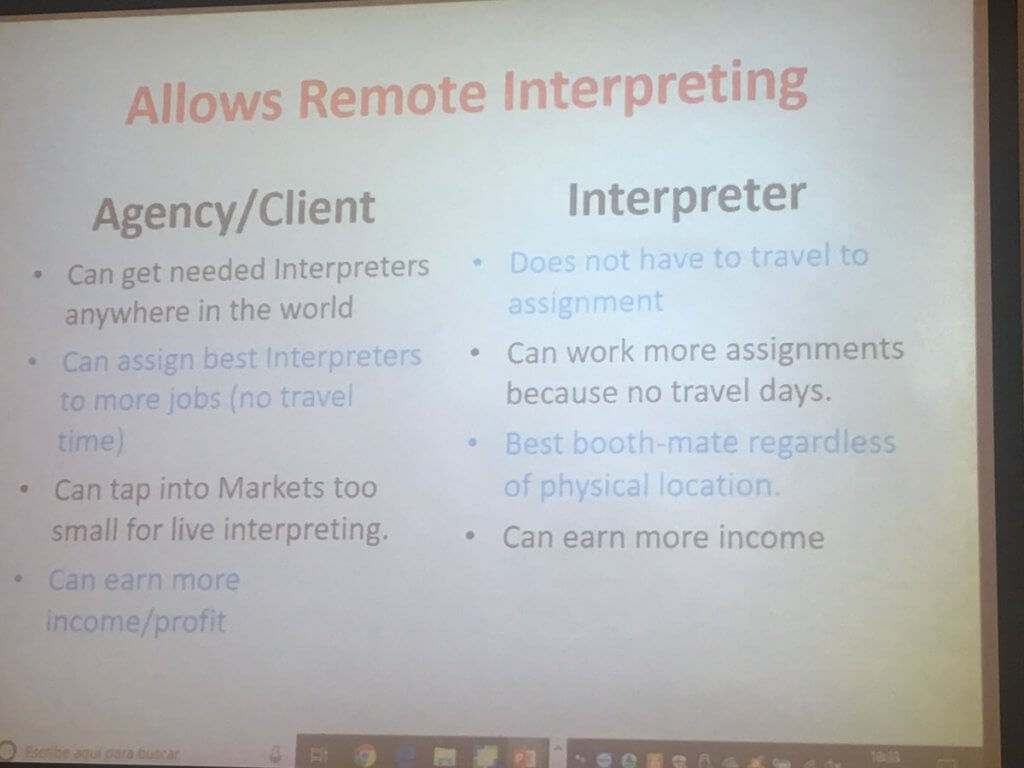
Then back to the interpreters’ room again to attend another presentation by Tony Rosado, in which he tackled the very controversial topic of remote interpreting. This reality is here to stay, but we interpreters need to embrace it only under certain conditions: that we are in the same place as our booth mate, that we get paid the same as we would onsite (and not per minute, only when truly interpreting, as we unfortunately start to see). This is possible for example with Kudo, among other solutions.
Saturday ended with a Basque pinchos dinner at another exclusive location.
Sunday
The dilemma of which talk to attend wasn’t any easier on Sunday. Alessandra even considered not attending her own talk to go to someone else’s presentation, but eventually decided it wouldn’t have been very polite to do so! 😉
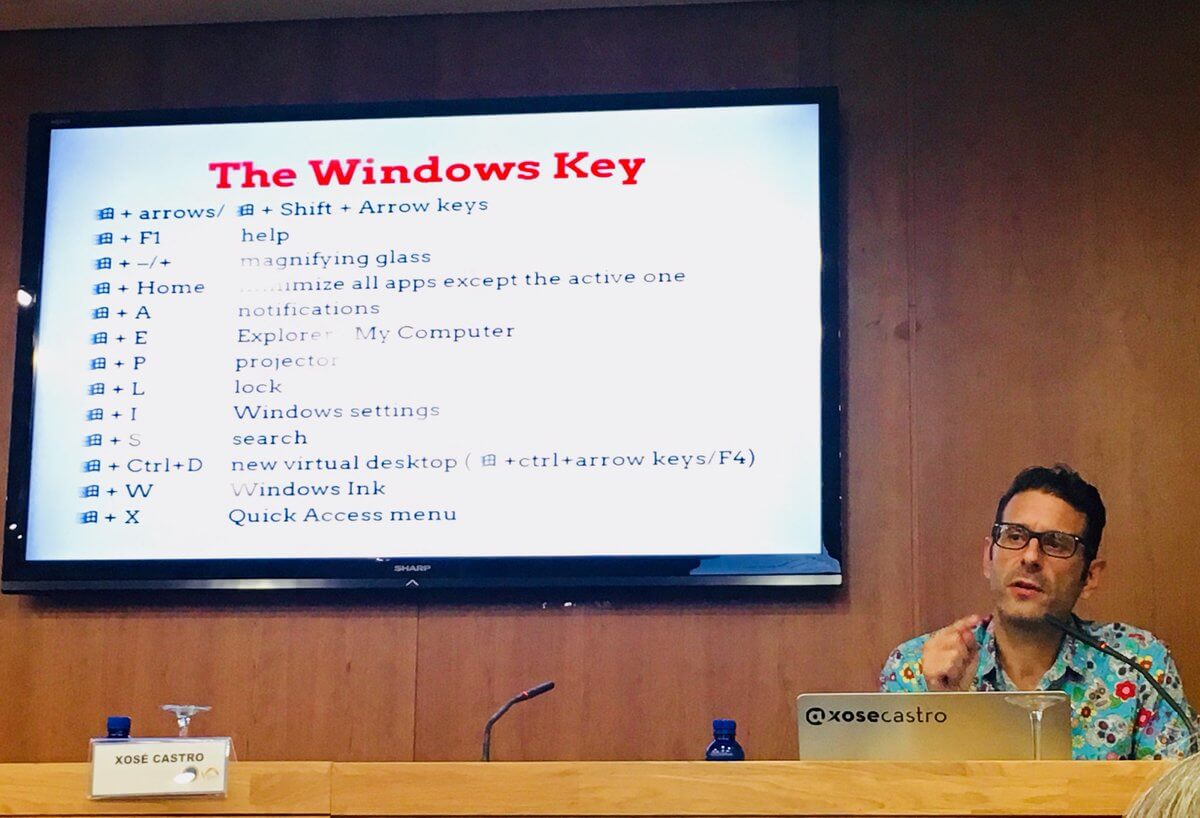
As always with Xosé Castro, the second day couldn’t have started better. In his very fun and comprehensive talk, Xosé hilariously shamed us a little to invite us to be more productive, offering many useful tricks and tools.
Sergio Viaggio, former UN chief interpreter, talked later about the legal and judicial interpreting settings. He also considered the pros and cons of retour, mentioning that nothing is either black or white, but it depends on the context (as always in our field).
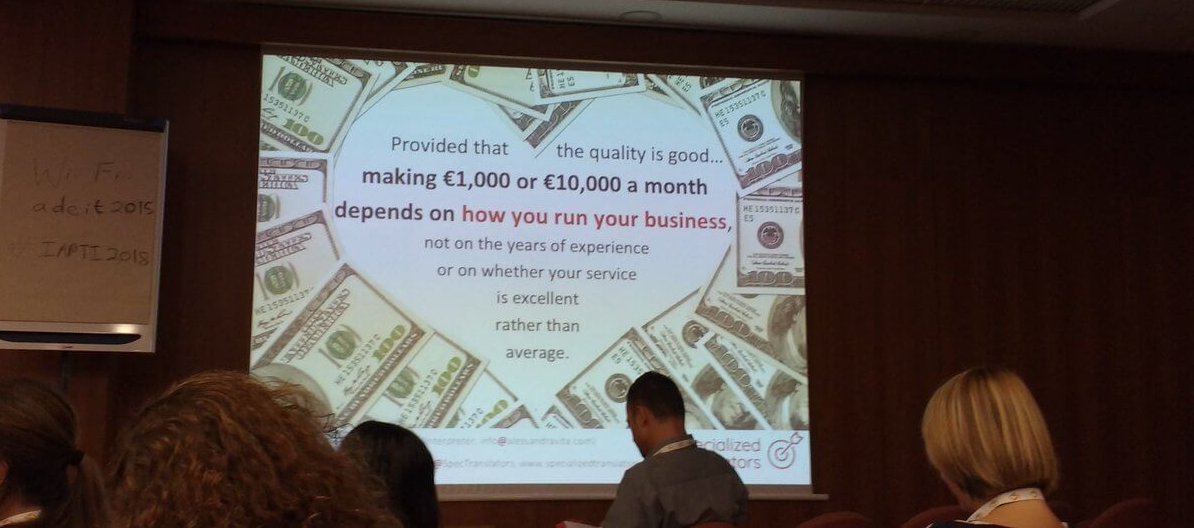
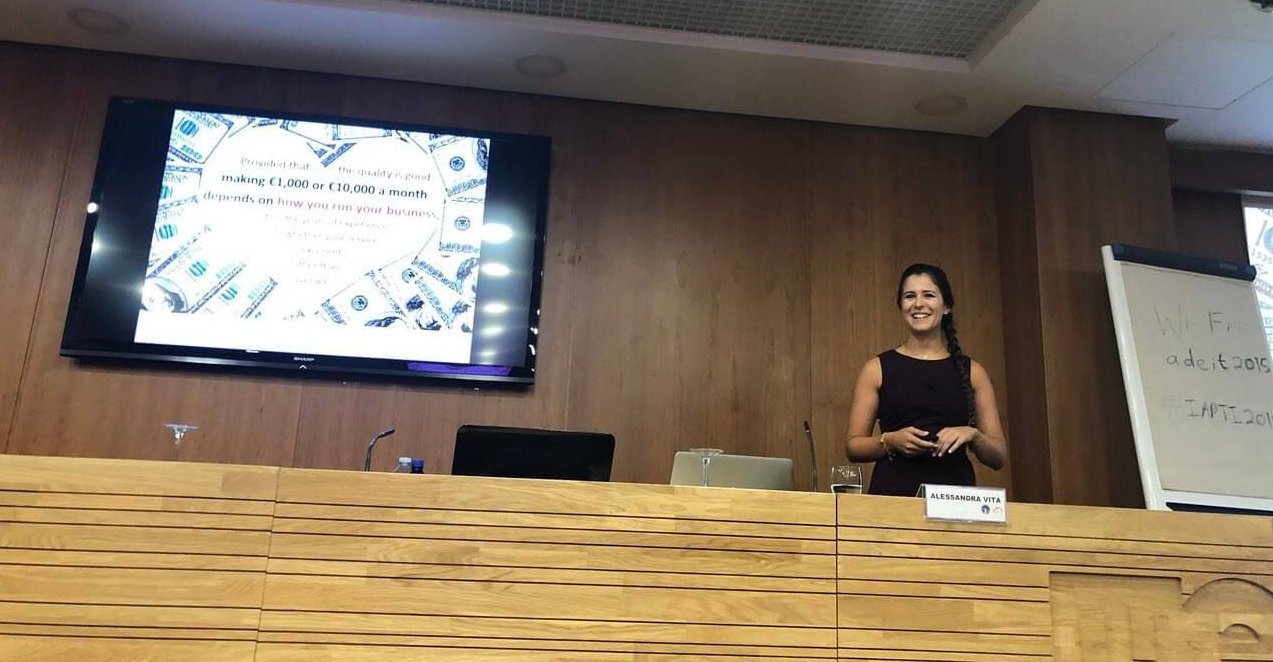
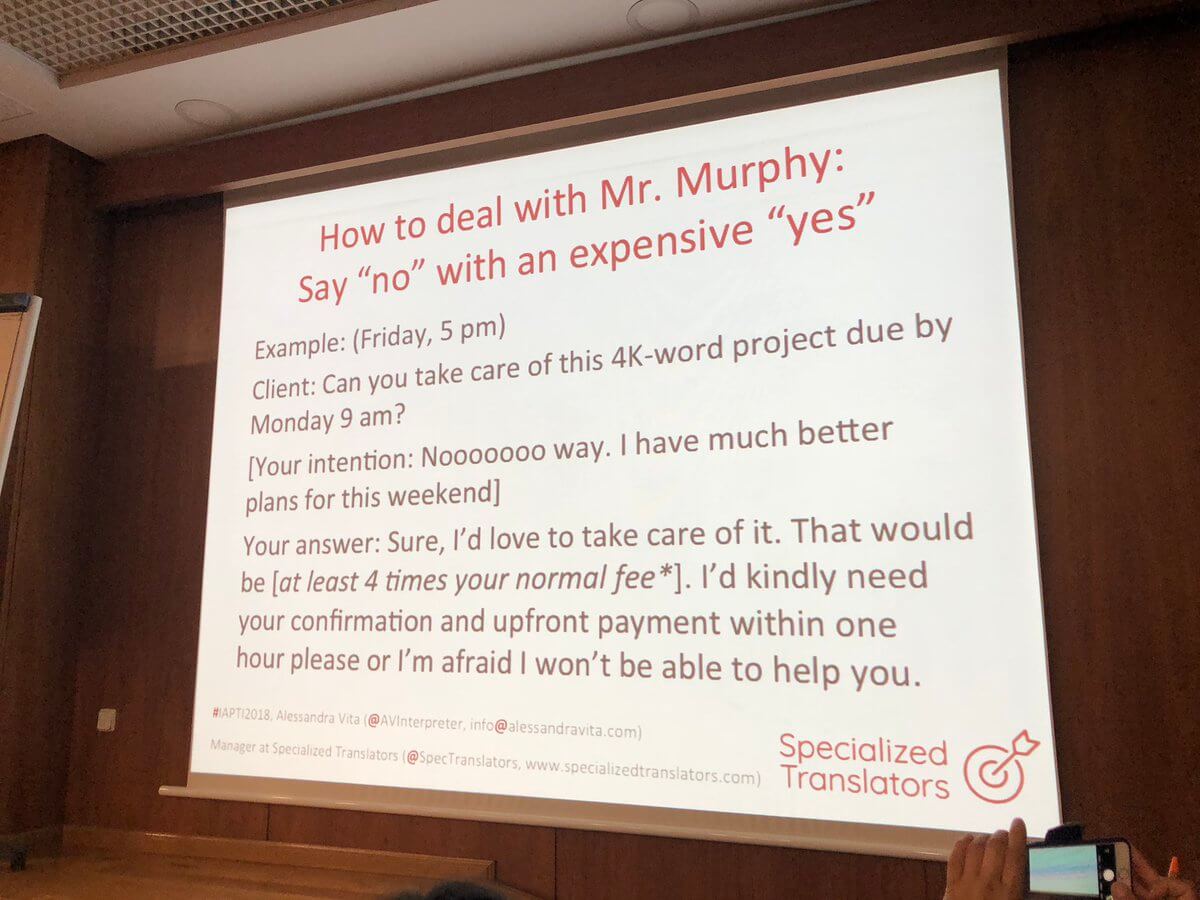
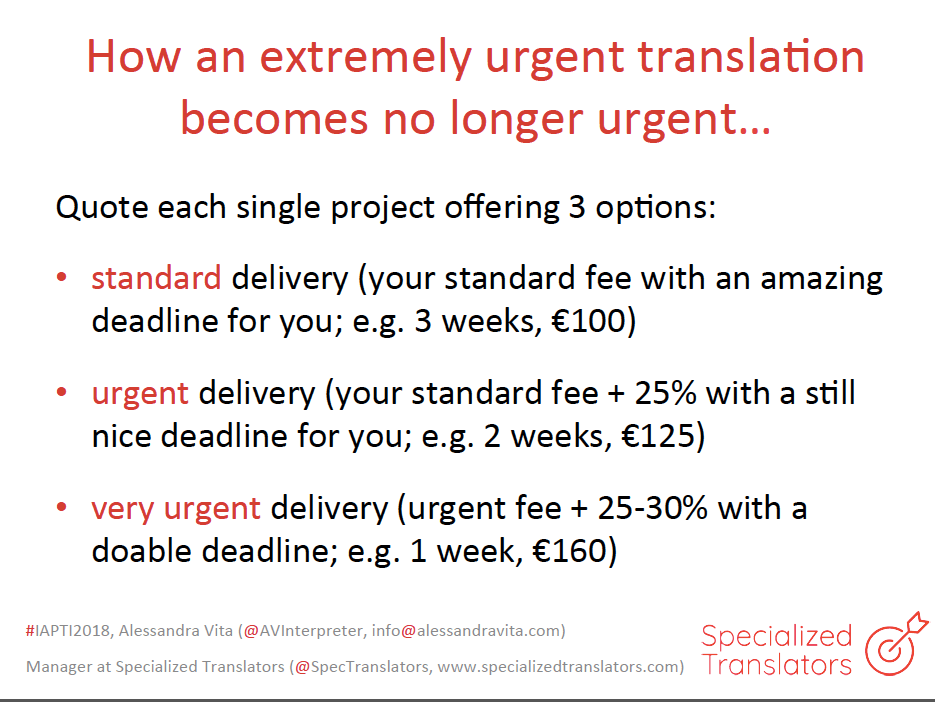
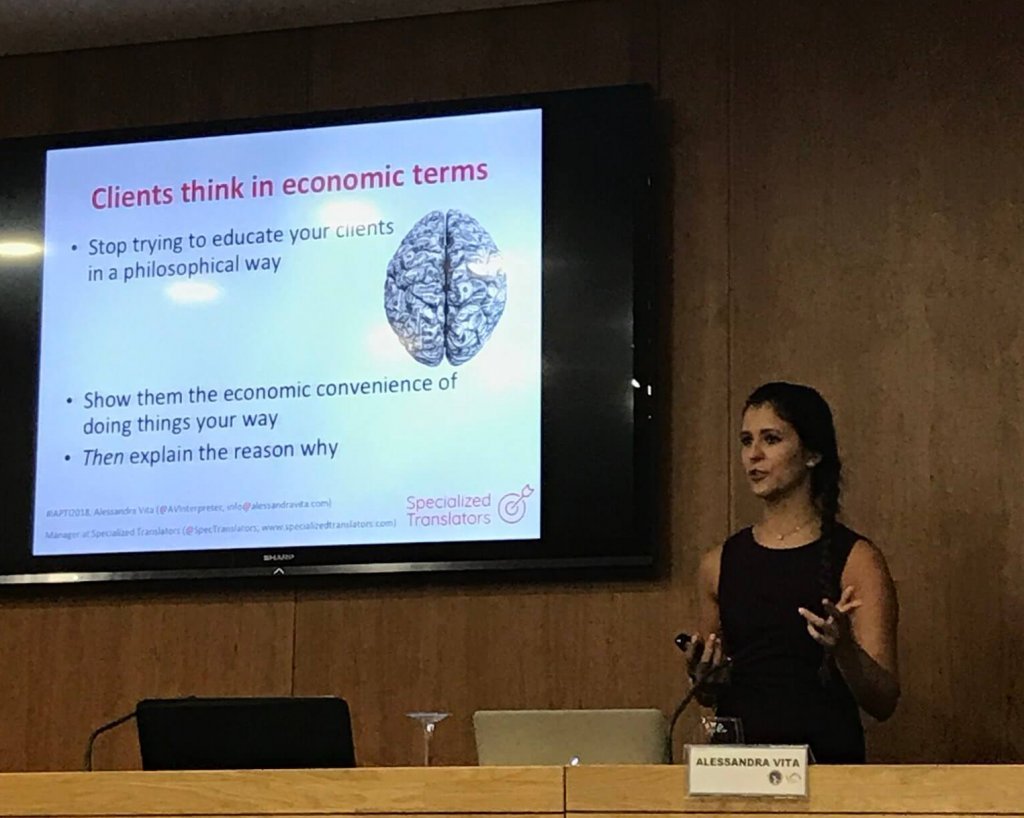
Then Alessandra, manager of Specialized Translators, spoke about running our business with direct clients and explained how to work less, under better conditions, while making more money. The idea behind her talk is summarised on her first slide.
Alessandra also mentioned well-tested and effective strategies on how to get amazing deadlines for translations, receiving plently of documentation many days before an interpreting assignment, how to cover our backs by including clauses in quotes to be signed by the client, and so on. In general, she recommended an economic and business approach to solve common problems we have to face on a daily basis.
Since many attendees asked for the link, below you can also find the video she used to show the toxic patterns that we need to eradicate in our profession and that would never happen in other industries.
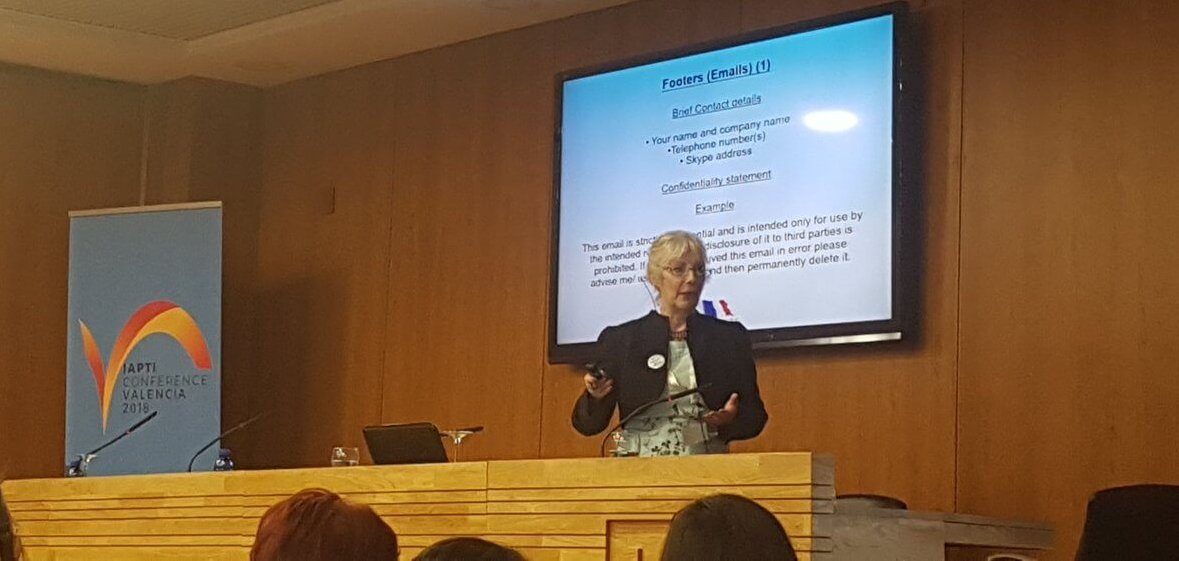
Afterwards, Sue Leschen spoke about the different documents we may need for our business: CV (she has a master CV from which she selects only the relevant sections whenever she needs to send a personalised CV to a client), contracts, quotes, estimates, business cards, among others.
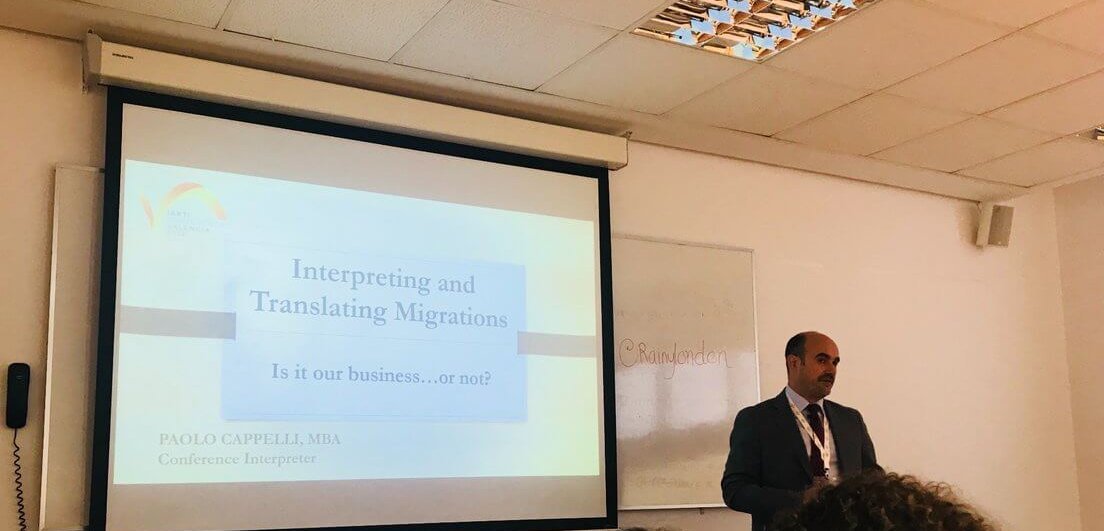
Before lunch, Paolo Cappelli offered a different perspective on the issue of interpreting for refugees and migrants, focusing on the historical and economic situation of Africa.
After another very tasty lunch, Stefan Schmidt explained the Aquarius emergency and the role of professional interpreters in similar circumstances.
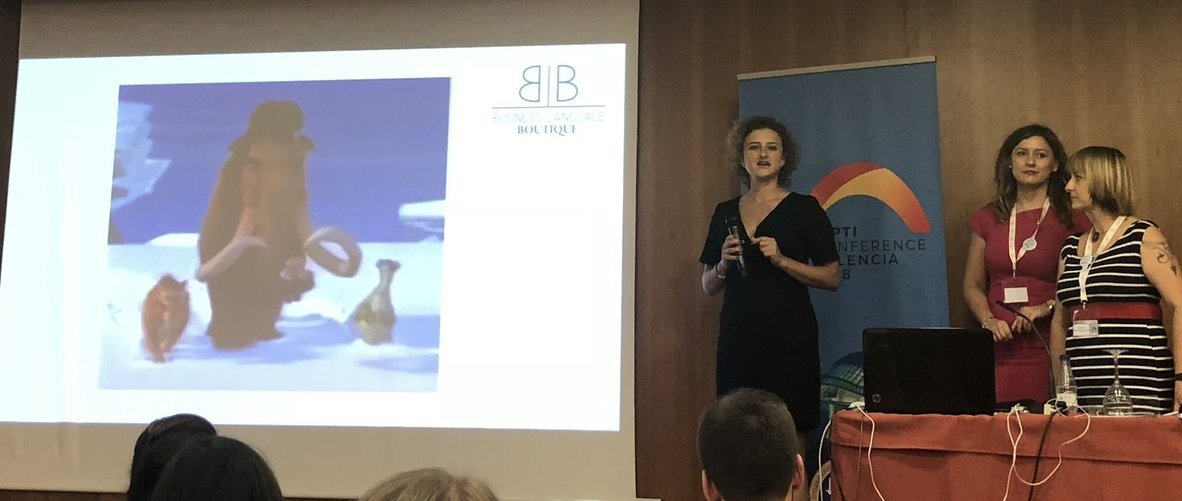
Another inspiring talk was offered by three Polish translators and interpreters: Katharina Wawrzon-Steward, Justyna Gutoswka, and Ewa Jasinska-Davidson. Apart from being freelancers with their own clients, they explained the history behind their common project, Business Language Boutique.
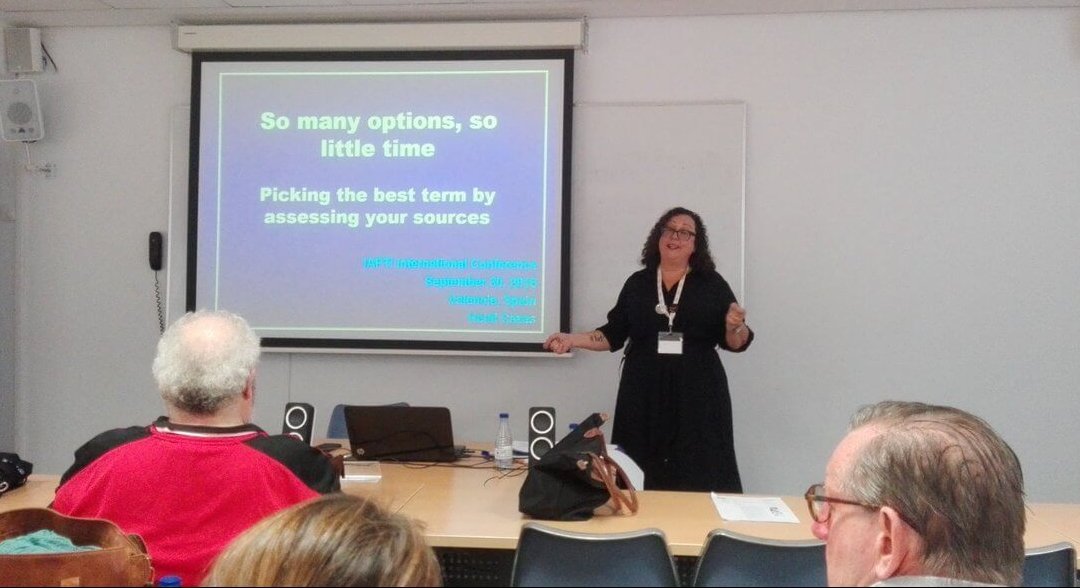
If you wonder how a terminology talk can be hilarious, ask the amazing Heidi Cazes-Sevilla, who explained how to assess one’s sources and choose the right terms when translating or preparing for an interpreting assignment.
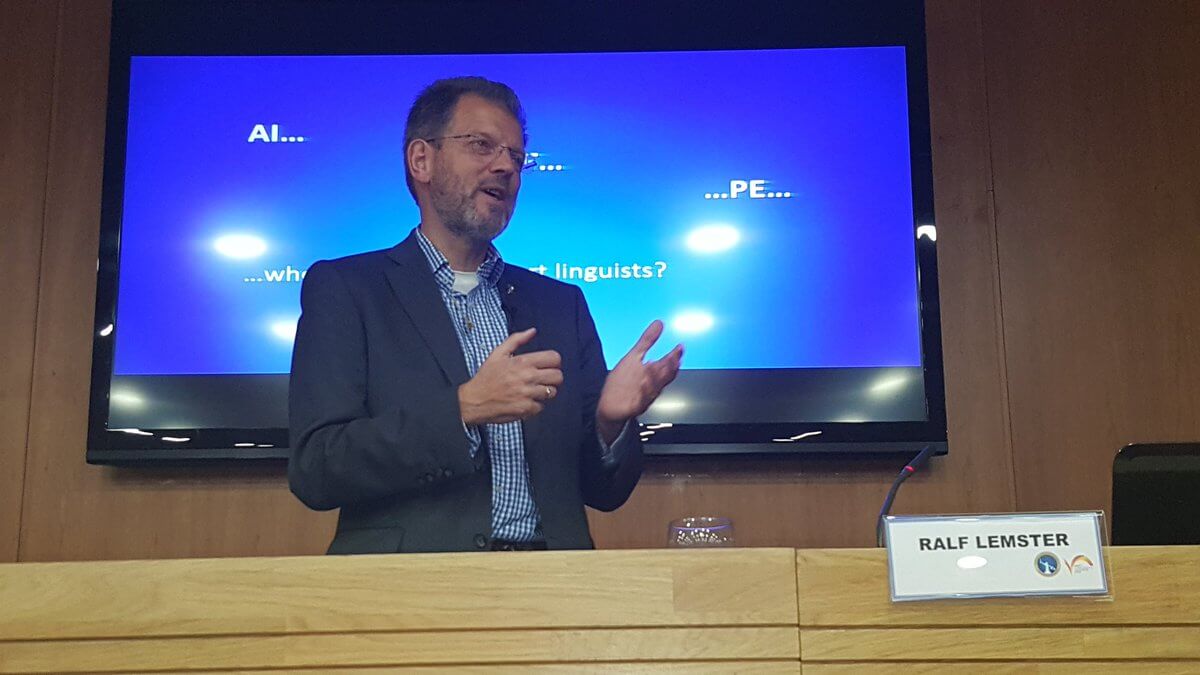
The final presention was delivered by the keynote speaker and charming financial translator, Ralf Lemster, who spoke about new realities of the translation business, such as AI, NMT and PE. Ralf explained that technology is changing the speed of our work, but every curse comes with a blessing. He recommended exploiting the technology available to our benefit, growing our network, improving technical and business-related skills, helping others, and exploring adjacent areas.
The end… for now
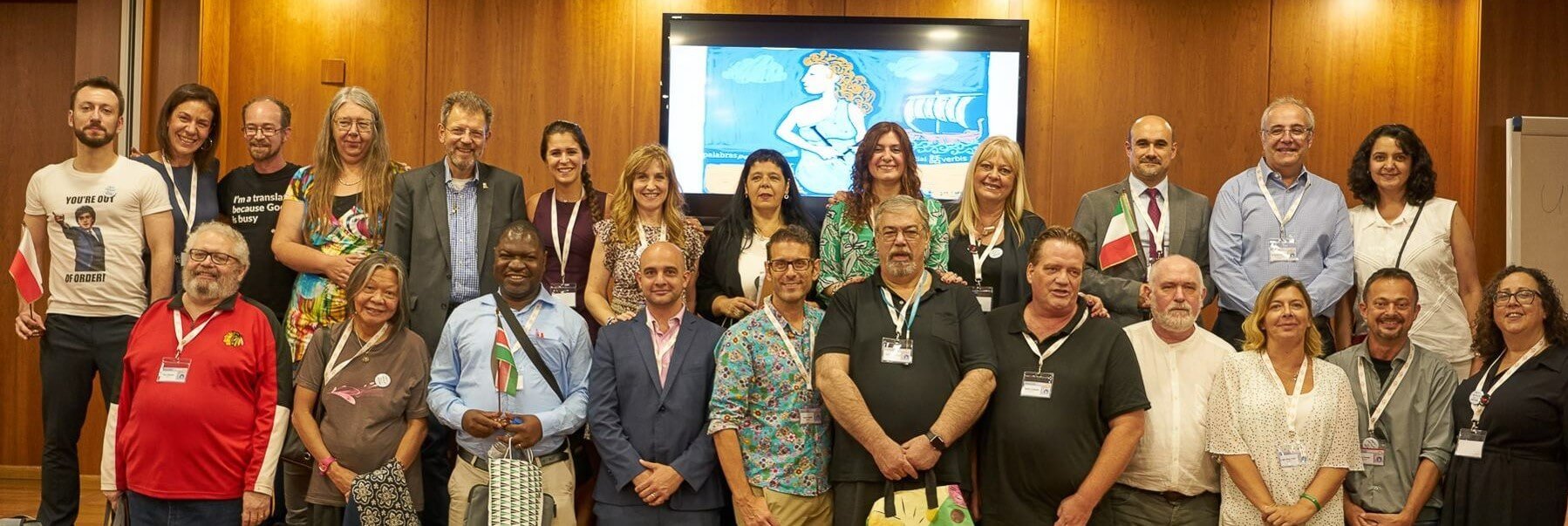
These three days were truly amazing and there was no better way to celebrate together the International Translation Day on September 30th.
P.P.S. Foodies definitely have to sign up for IAPTI2019 next year (please don’t watch below if you are already hungry and if the fridge is too far away!).
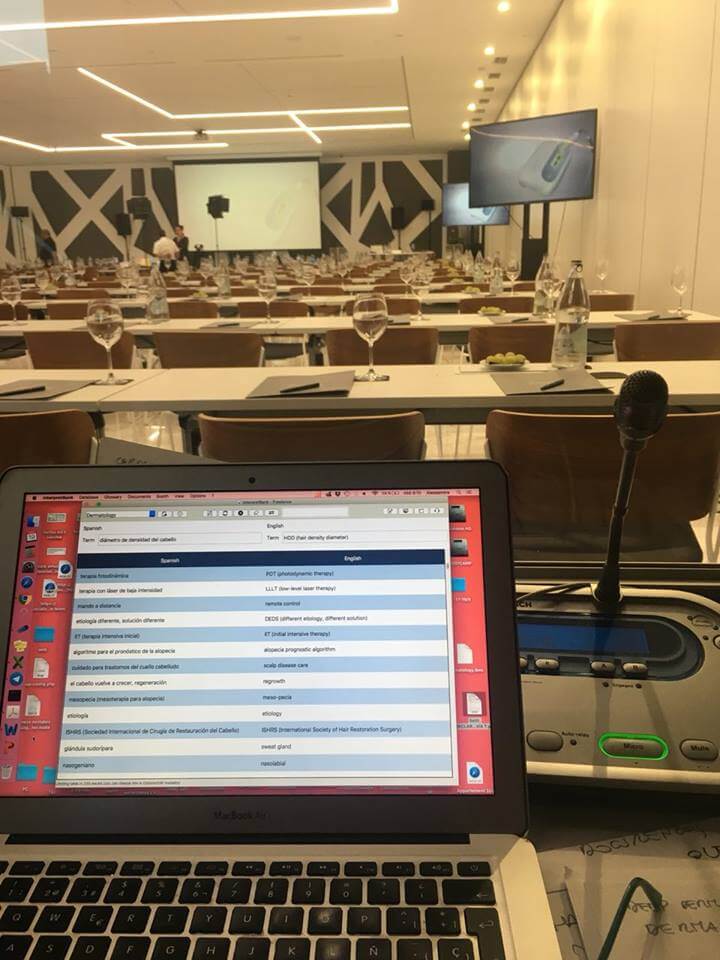
Last week Specialized Translators provided a four-day Spanish-into-English simultaneous interpreting service during a technical conference on dermatology in Calpe (Alicante, Spain).
Whoever is familiar with this field is aware of its complexity: when you speak of derma products it’s not just about marketing, you have to deal with complex medical and chemical concepts, together with its terminology.
This is why time is not your best friend when the client requests the service last minute on a Thursday evening to confirm it on Friday morning and the assignment starts on Monday.
Preparation is key before each interpreting assignment
We interpreters need to study before each event. We are not born experts of all fields of human knowledge. Plus, the more technical the assignament is, the more we have to study. As simple as that. And even when you have previous experience on the same topic, each company is a different world in terms of products, active ingredients they use for them and so on.
In addition, fellow interpreters can confirm that once the assignment is over, your memory needs to get rid of all those terms you had to recall in another language in a matter of a second or less for the previous assignment. This is why unless you interpret each week about the same topic, you need to study again the material you had previously prepared for a related assignment.
It’s essential that the client understands the importance of providing plently of documentation on what speakers will talk about (mainly the PPTs that are going to be displayed). This is the best way for us interpreters to optimize our preparation before the event and ensure the best performance on the days of the conference.
How we prepared in this case
In this particular case, we couldn’t waste any time waiting for the documents since we weren’t sure if and when we would get them. This is why we spent the entire weekend preparing: we read each and every section of the client’s website, extracted all the technical terms we might need during the conference, included them in a glossary together with the equivalents in the target language, apart from studying all revelant concepts we might have to deal with. By Saturday at 3 pm, our draft glossary had already 450 terms, and that’s when we received the first PPTs from the client. By the end of the process, the glossary reached 800 terms, most of which where active ingredients and long chemical compounds, which were extremely hard to even read (sometimes even by the experts themselves, that was reassuring for us).
Of course, having 800 terms in written in your glossary is not enough. You need to memorize them so that whenever they come up in the talk, you’ll be able to immediately recall the equivalent term in the target language.
When you study hard, there is always a happy ending
Personally, even though I always get the impression that there is no way my memory can cope with so much terminology in a short amount of time while preparing, when the microphone is on on the big day, the magic simply happens: thanks to the adrenaline of the assignment combined with the long hours of preparation, I somehow manage to find the right term at the right time stored somewhere in my busy brain.[dt_divider style=”thin” /]
For more pictures of the event, you can check our Facebook page.

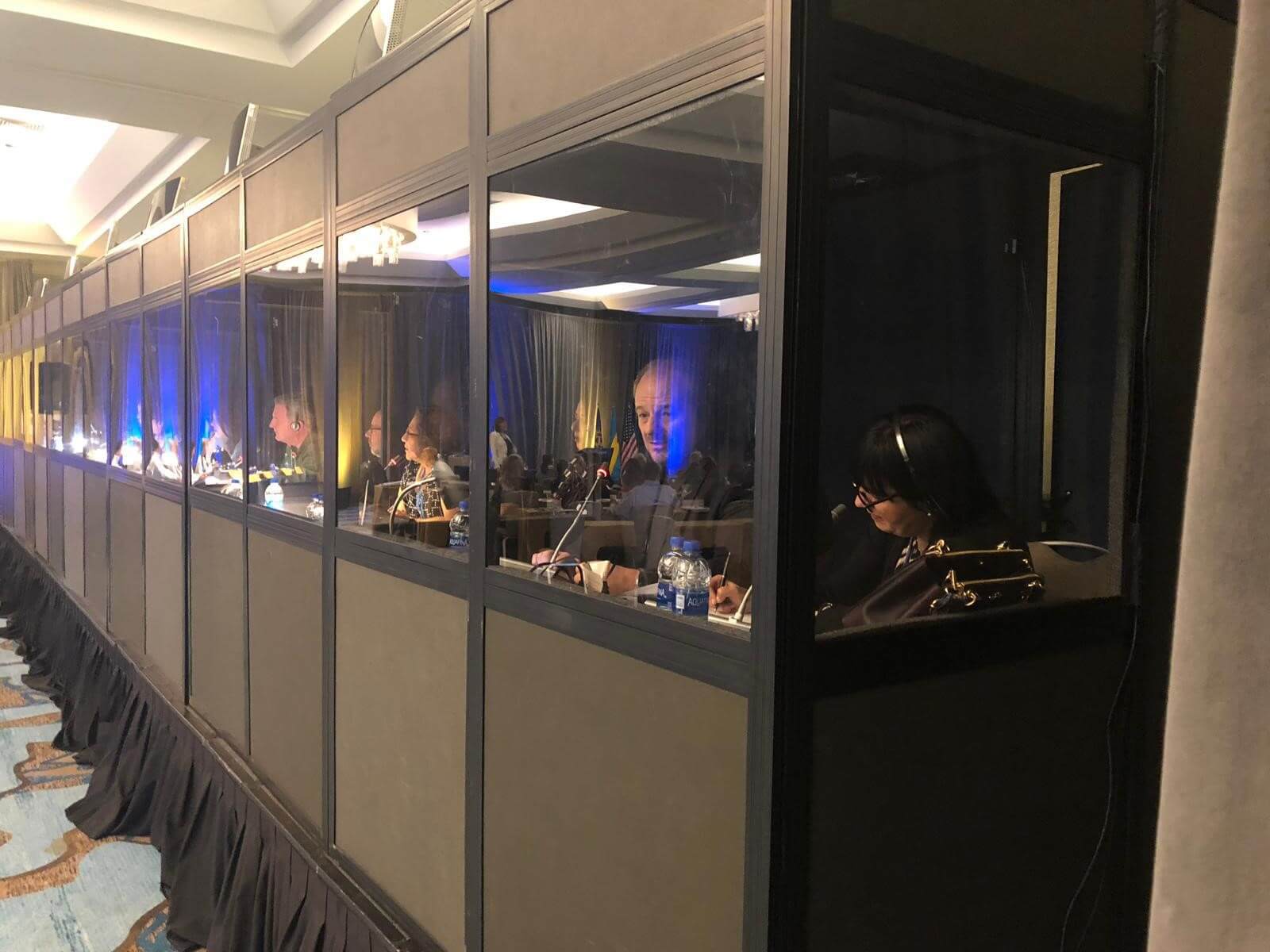
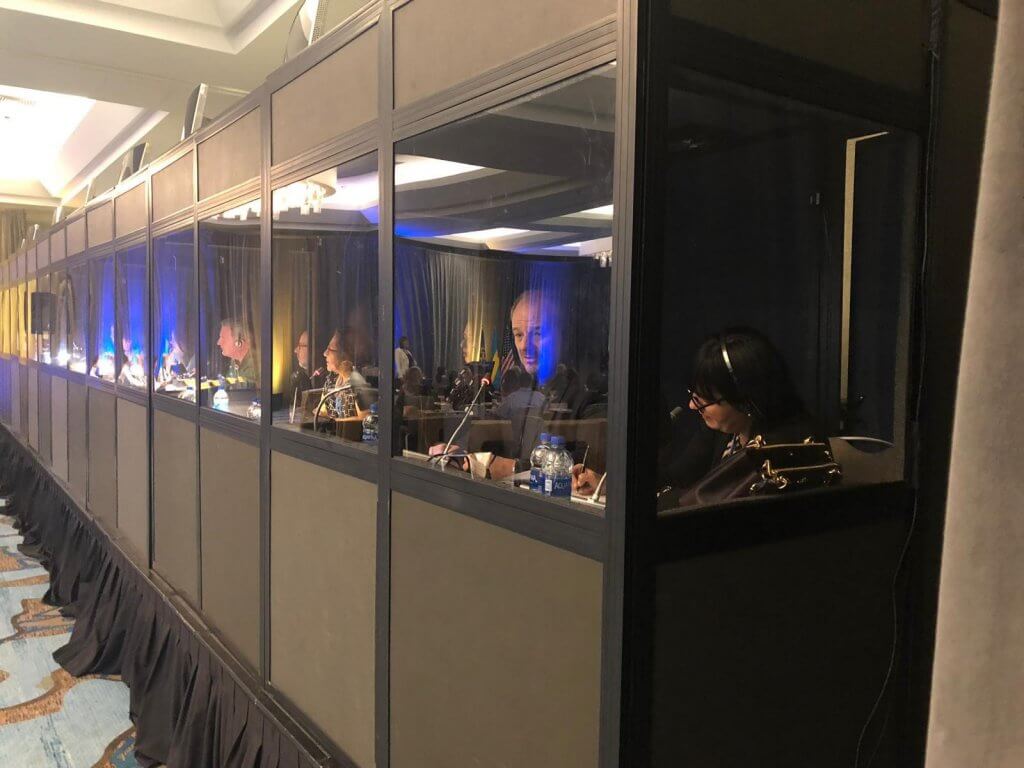
 In the past few days we have been busy interpreting at the best multilingual conference ever. With attendees from all over the world and 12 amazing interpreters divided in six booths (English/Spanish, French, German, Italian, Portuguese, and Russian), this has been the best example of a multilingual conference we have seen so far.



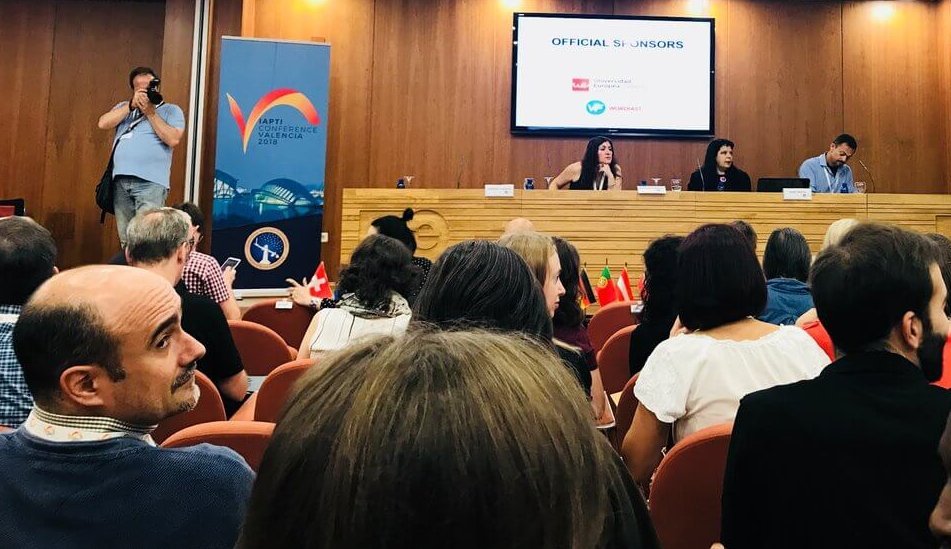
 All this was possible thanks to the great IAPTI team, featuring president