Tag: remote interpreting

  • Over-the-phone remote consecutive interpreting

    Over-the-phone remote consecutive interpreting

    In the last post we talked about the challenges in remote conference interpreting, especially focusing on simultaneous interpreting. Today, instead, I’d like to focus on remote consecutive interpreting, more in particular considering the over-the-phone modality.

    Apart from onsite interpreting jobs (95% of the cases for me), more and more often in the last 3-4 years I have provided over-the-phone remote consecutive interpreting services for a US consulting company. It is for small meetings of only two people in general, in which a consultant or an investor from a country contacts an “expert” of the field based in another country, to carry out a market studies or tackle financial enquiries.

    I actually started working with this US consulting company for onsite services, with the first meeting in Madrid between an Australian investment group (coming to Madrid all the way from the land down under) and a local expert.


    Advantages of over-the-phone consecutive interpreting

    Without generalising, I have to say that for this kind of meetings and for my specific circumstances and logistics, I find the remote service much better than the onsite meetings. Since they are never going to take place in Alicante (where I am based), doing it over the phone saves me all the travelling organisation, travelling time, and the client doesn’t have to pay for travelling costs.

    Everything goes through an efficient and automatised platform, so I don’t have to send a quote each time (as I would for onsite assignments, always requesting an upfront payment): they already have my fees on their database; they send me an invitation; I accept it indicating my availability; the meeting is confirmed, and at the end of the call I automatically receive the payment.

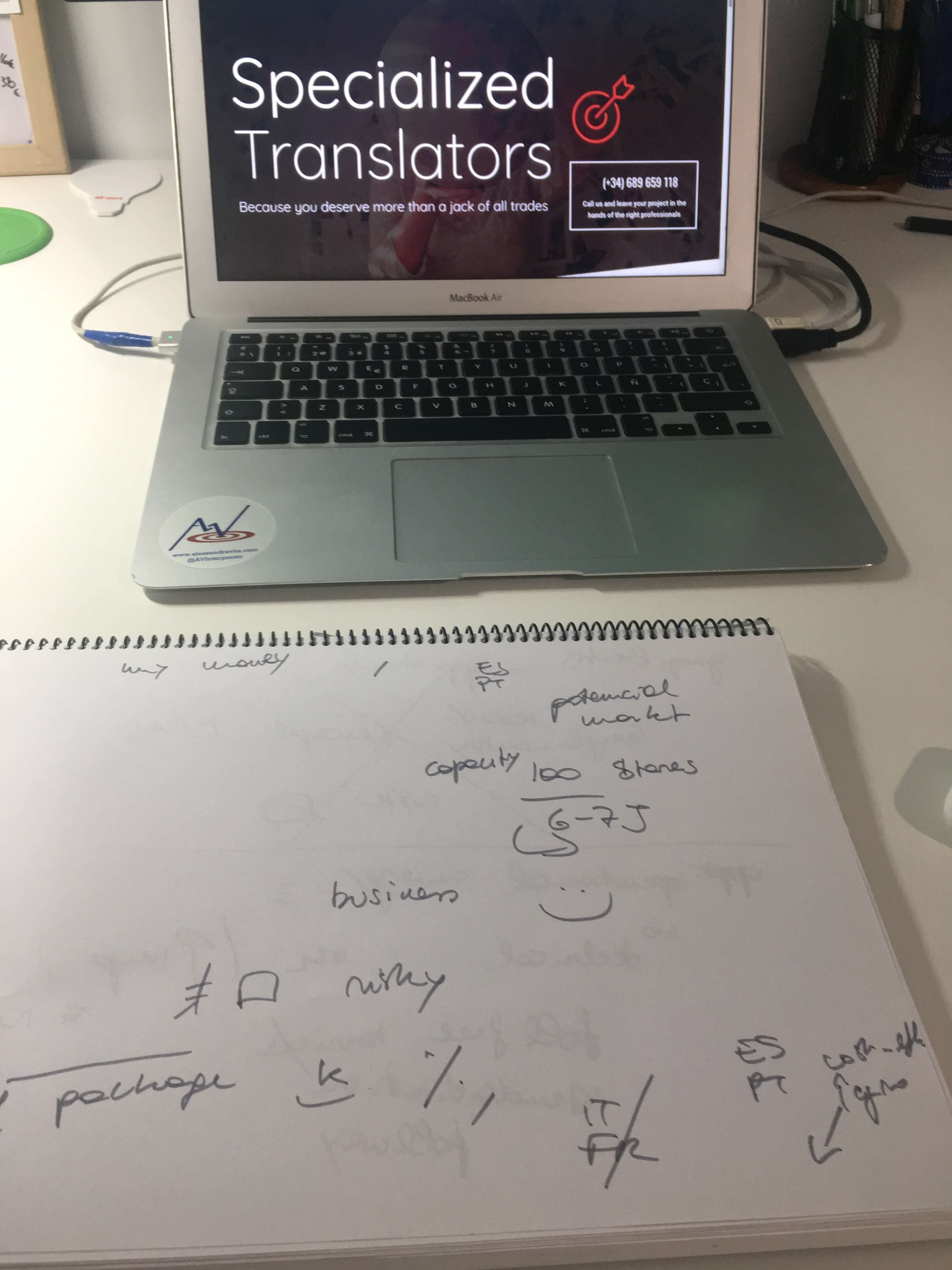
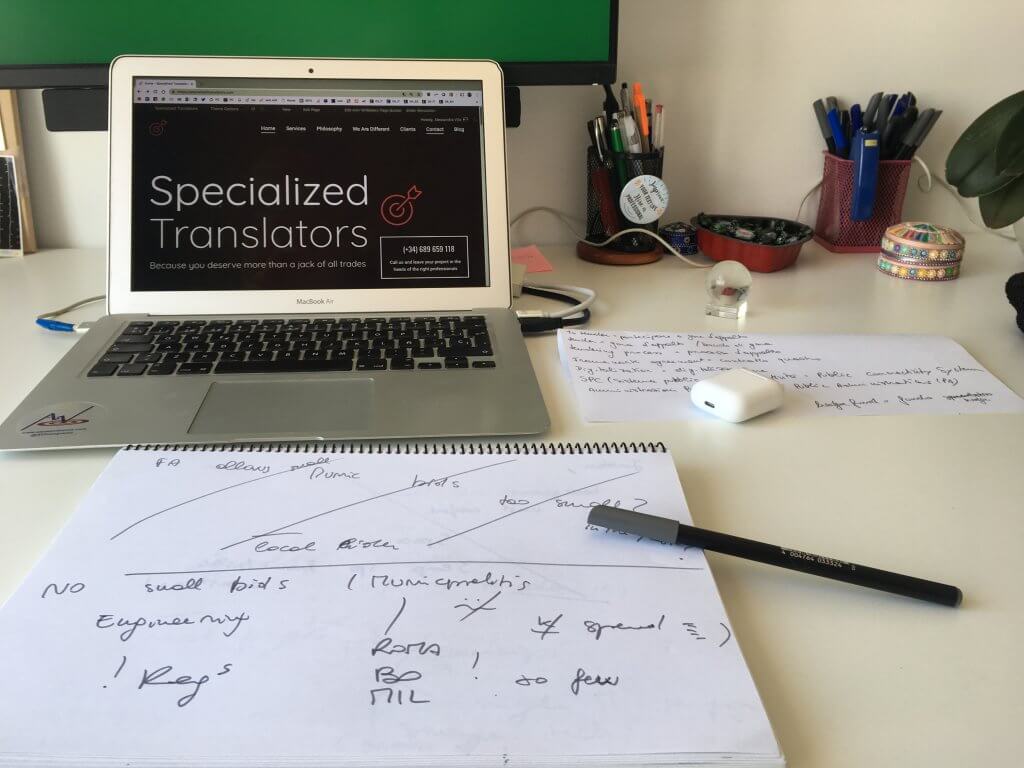
    I would be alone anyway in this kind of consecutive assignments, so the booth mate is not an issue here. I don’t have to fear potential issues with my Internet connection, either. It’s a simple call without video, so I can wear my AirPods (which I am deeply in love with). I comfortably take notes with a big, handy notepad on my desk (I don’t have to hold it in a very elegant yet uncomfortable way as in a face-to-face situation). Plus, I can fill my desk with all the glossary sheets and notes I want. Also, another good advantage is being able to look up anything on the Internet, if I need, without anybody noticing a thing.

    Again, it’s a very specific type of meetings, where the non-verbal component plays almost no role, in my experience.
     

    note-taking consecutive

    Disadvantages of over-the-phone consecutive interpreting

    The only slightly-tricky part might be voice overlapping (e.g. the expert makes a pause and I start interpreting believing he’s done, but then he wants to add something else he just remembered). Yet, this is far from a big issue; I would simply say, “Sure, go on”, and problem solved.

    Furthermore, exactly as in onsite meetings, some speakers want to talk for ages, leaving the other person having no clue of what is being said for 20 minutes, and that’s when you should try to delicately set the timings to avoid the listener’s frustration.


    In other words, I do exactly the same I would do onsite, but more comfortably; I apply the same economic conditions, and lose no time travelling (and, as they say, time is money); plus, the client doesn’t have to pay for travelling costs. In this very specific case, I think that it’s definitely a win-win situation for everybody involved.


    A very different story is remote conferencing interpreting for big events. If you missed it, have a look at the previous post about the challenges in remote conference interpreting, where AIIC guidelines on remote interpreting are also mentioned.


    As always, if you’d like to share your experience and insights, you’re more than welcome to do so on the comments below. Thanks and see you soon!
  • Challenges in remote conference interpreting

    Challenges in remote conference interpreting

    Resultado de imagen de yeti microphone pc screenRemote interpreting is here to stay, whether we like it or not. Exactly the same happens in translation with machine translation (MT) and post-editing. Technology is disrupting every industry, not only ours. Yet, we don’t expect them to become a one-size-fits-all solution any time soon, meaning that neither every type of document will be translated with MT and then post-edited, nor will all interpreting assignments be provided remotely, and that is for very good reasons.

    New and fear go often hand-in-hand, but in general there always some pros and cons in every change. For several years I have been providing over-the-phone consecutive interpreting for a client, and based on my experience it has great advantages, as I will mention in the next post. Yet, when it comes to remote conference interpreting for a big event, it’s a different kind of story and I think there are still challenges we need to overcome for it to be a viable option.

    This is the service I am most skeptical about providing remotely (in fact, I still don’t). The reasons are mainly three:

    [dt_gap height=”20″ /]

    Technology

    Right now, I don’t trust technology that much to feel comfortable interpreting from my office. That would imply trusting, on the one hand, that my Internet connection will cooperate smoothly and, on the other, that there won’t be any audio and video-related issue (since the AV technician won’t be physically there to solve it).

    [dt_gap height=”20″ /]

    Money

    So far the only agencies with remote-interpreting platforms that have contacted me for this kind of services tried to impose me a rate per minute (in general €1 per minute) of actual interpreting, which is absurd and far from acceptable. That means, for example, that if the event starts 30 minutes late I am not paid for that time I have been sitting in front of the screen just waiting, nor will I get a cent during coffee breaks or lunch. Plus, what if the conference lasts for only 40 minutes instead of all day? Will I be paid €40? How can all the preparation be cost-effective then?

    For all the above, when receiving that amazing offer, I replied that I was willing to give it a try, but applying my standard fees as if it were a standard onsite conference (charging from the minute I am requested to be there, till the moment I switch off the microphone at the end of the day, but not per minute!). The end client could still save on travelling costs, and since I have to travel 99% of the times from an assignment to the other, I would be more than happy myself to reduce some travelling, but only if good working conditions are safeguarded.

    I believe it’s too late to expect that everybody could charge decent fees and apply top conditions for onsite assignments, but hopefully we still have time to prevent bad practices from becoming common.

    [dt_gap height=”20″ /]

    Booth mate

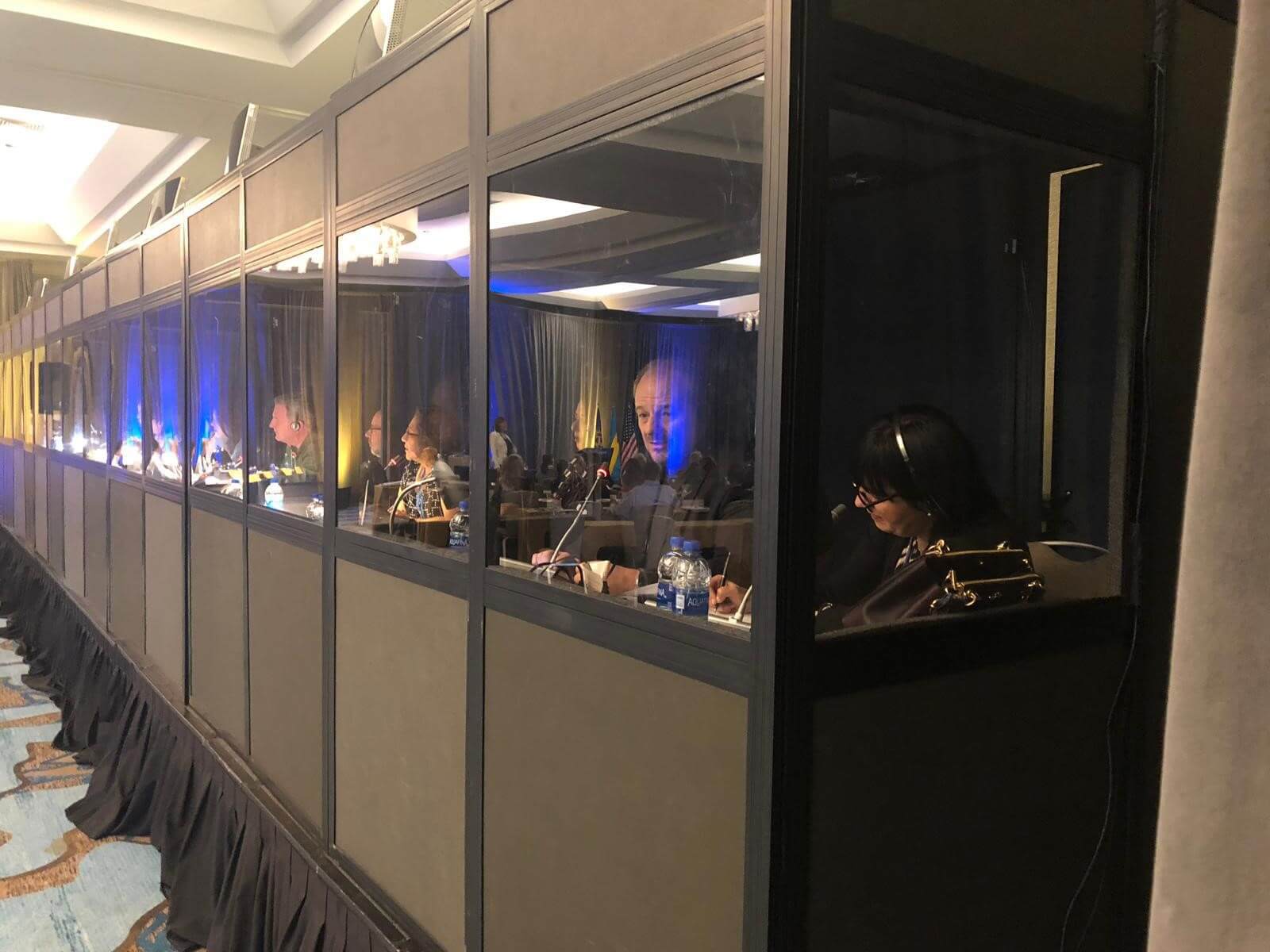
    Simultaneous interpreting is a team effort, every professional interpreter knows it. It’s not just a matter of turns, of you doing your 30 minutes and then handing the microphone over to your colleague so that your brain can recover. Being physically next to your colleagues allows you to communicate with them even non-verbally: you may just look at them during your turn to implicitely ask them if they got the last idea, figure, name or to tell them that it would be a good time to change.

    As far as I know, most online platforms currently available in Europe request you to talk with your colleague through a chat, which is far from ideal in my opinion. It’s an additional task that can distract rather than help us. If I were physically with my booth mate in a standard booth, just with a look, the colleague would know if I need help with a term and exactly which one. Via a chat, either colleagues write down everything just in case (which I would find distracting) or I would have to type what I’d need from them. Instead of doing that, I might as well just look it up myself.

    For the same reason, according to AIIC guidelines on remote interpreting, both partners should be interpreting together from the same physical location.

    [dt_gap height=”20″ /]

    A viable remote-interpreting solution in the US

    Image courtesy of KUDO.

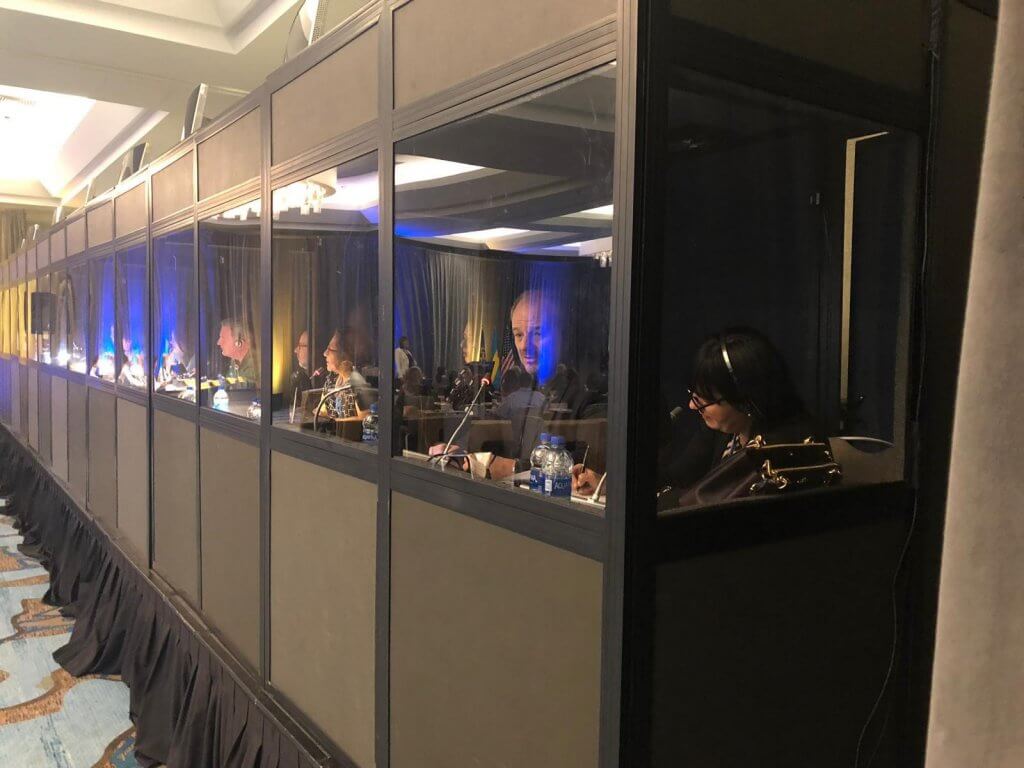
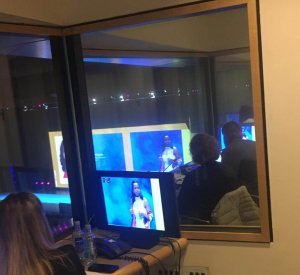
    The best solution I have heard of so far is KUDO, a US company allowing you to go to an interpreting studio in the main US cities, such as NYC or Chicago; there you would have a standard ISO booth, which you would share physically with your booth mate, and you would follow the conference via a screen. Plus, you would be able to rely on the support of an AV technician taking care of any technical issue for you.

    I find this a good solution for a big country like the US, where distances are huge. Yet, personally, I don’t think it is likely to work well in Europe: if they set an interpreting studio in Madrid or London, I might as well just go onsite to the conference, with travelling costs being the same. The only advantage would probably be the chance to provide interpreting services in different time zones (e.g. in the European case, for Asia and the US).

    [dt_gap height=”20″ /]

    The remote-interpreting debate is definitely still work in progress, so I reserve the right to change my mind based on new evidence and experience gained in this field.

    And you? What do you think about it? Do you already provide remote conference-interpreting services? Which platforms or systems do you use? How has your experience been so far? Leave a comment below. 🙂


    References: AIIC guidelines on remote interpreting