
These services can be provided individually or combined as part of the same multilingual event setup.
Live streaming
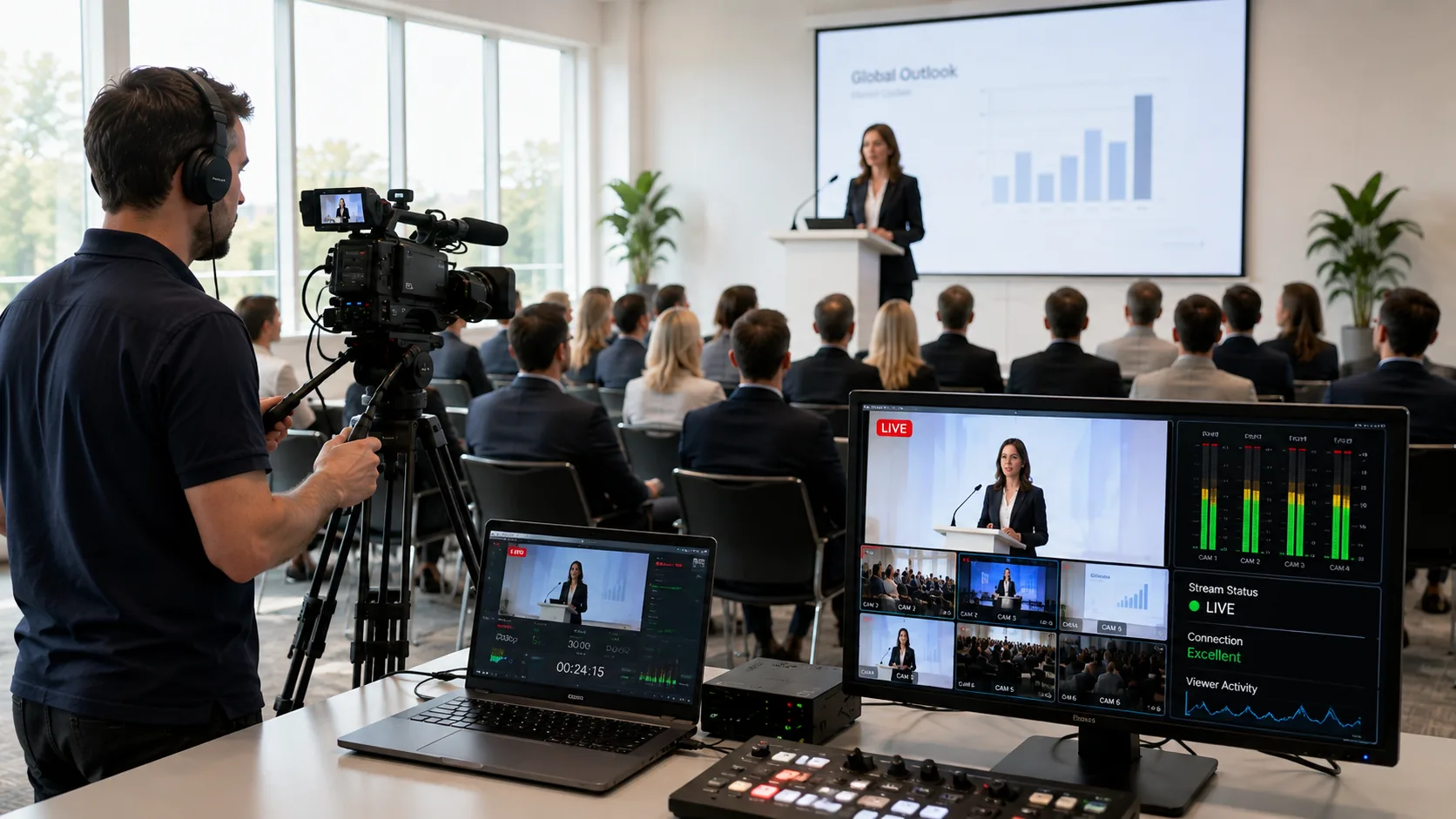
Stream your multilingual event to participants who are not physically present, while allowing them to follow the event in the appropriate language.
The interpreting setup can be integrated with the streaming environment so that, where supported by the platform, remote participants can choose between the original audio and the relevant interpreted language channel.
Read moreRead less
Multilingual live streaming
Streaming a multilingual event requires more than simply sending the main audiovisual feed online.
The interpreters must receive the correct source audio, and the remote audience must have access to the appropriate interpretation.
Depending on the event and platform, this can involve:
- selectable interpreting channels;
- separate streams for different languages;
- integration with onsite simultaneous interpreting;
- remote interpreting;
- remote speakers;
- hybrid audiences;
- technical monitoring during the event.
We can coordinate the multilingual part of the workflow with the client’s venue, audiovisual supplier or streaming provider.
For complex hybrid events, a technical rehearsal beforehand is advisable.
Recording
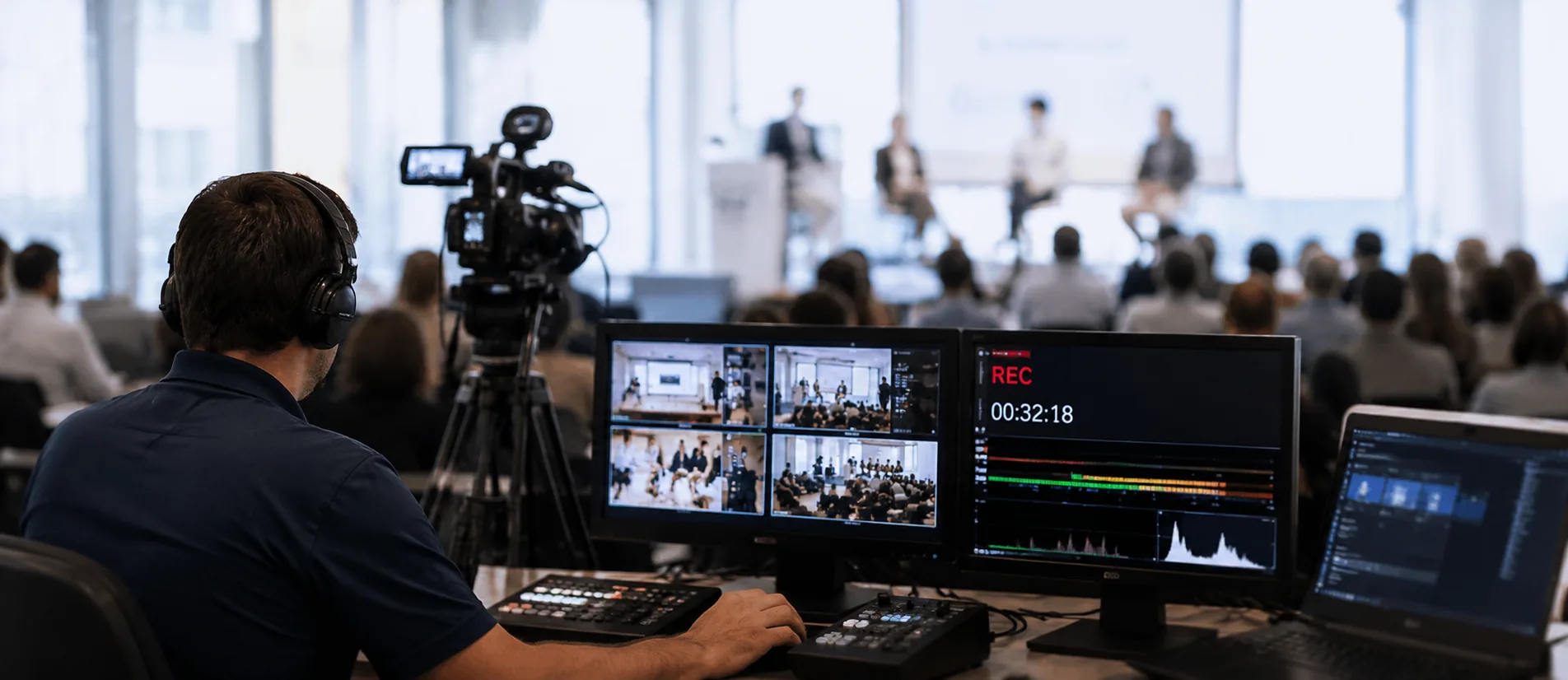 Record an interpreted event while preserving the languages that will be required afterwards.
Instead of recording only the original floor audio, the technical setup can, where supported, preserve separate interpreted language feeds so that different versions of the event can subsequently be produced.
Read moreRead less
Recording multilingual events
The recording requirements should ideally be defined before the event.
For example, a conference interpreted from English into Italian and Spanish might require:
- the original floor recording;
- an English-language recording;
- an Italian-language recording;
- a Spanish-language recording.
This is particularly important when the recordings will later be used for:
- internal distribution;
- training;
- publication;
- webinars or online platforms;
- conference archives;
- post-event communication.
We can coordinate the recording requirements with the interpreting and audiovisual setup so that the necessary audio feeds are available from the outset.
Live captioning
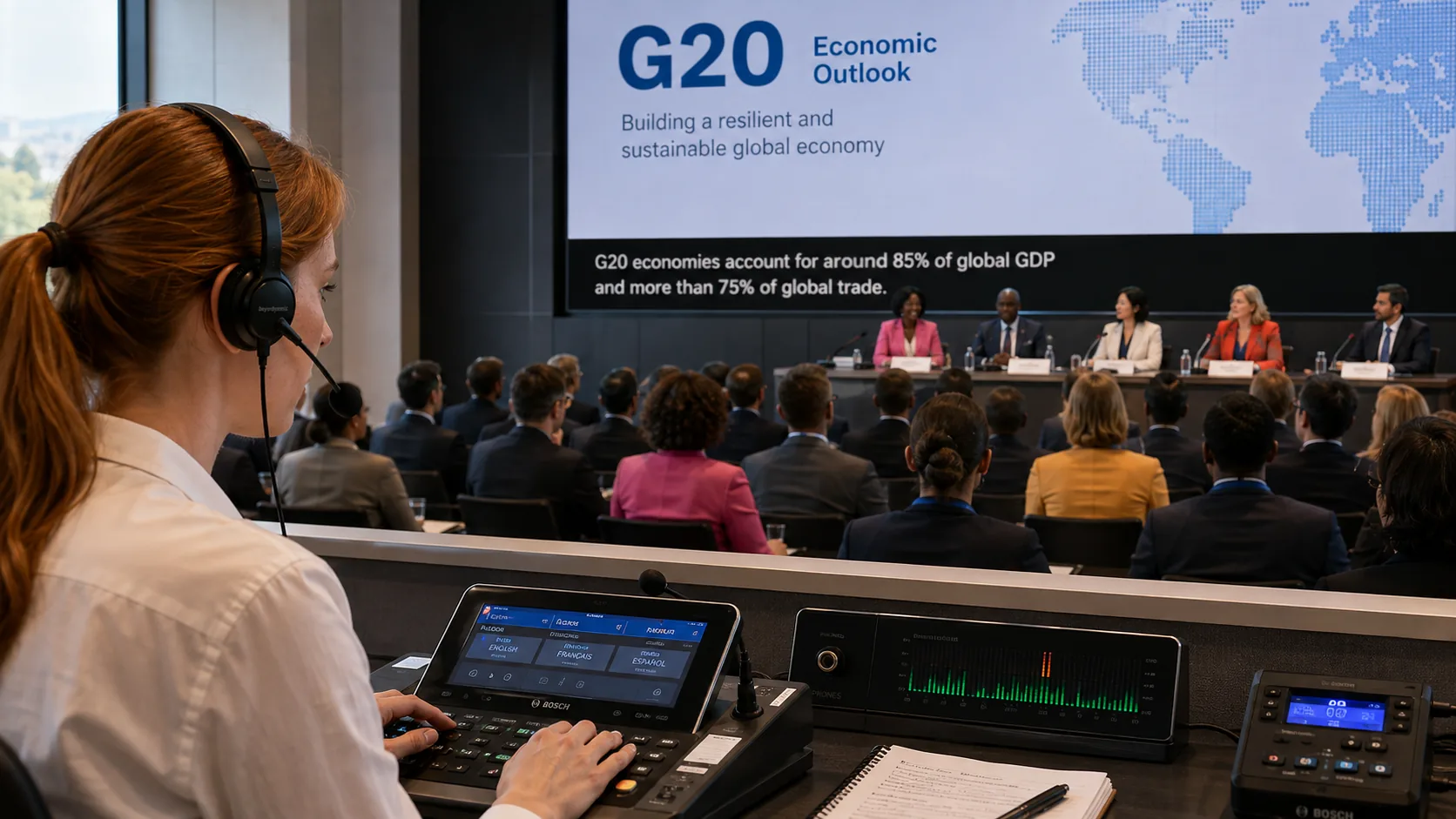
Provide real-time written captions of spoken content, produced by professional real-time captioners specialising in live speech-to-text.
In multilingual events, live captioning often works alongside simultaneous interpreting. For example, at an event in Spain interpreted into English, Italian and German, the English captions may be produced from the English translation, allowing participants to listen in English while also following English captions.
Live captioning can be particularly valuable for accessibility — for example, for deaf or hard-of-hearing participants — and as additional support when following technical presentations.
Read moreRead less
Captioning and interpreting
In multilingual conferences, captioning can be produced either from the original speaker or from one of the interpreted languages.
This allows participants to listen naturally to the interpretation while using captions as additional visual support.
How live captions work
Live captions are different from the subtitles of a film or pre-recorded video.
Because they are created while somebody is speaking, the text normally appears progressively and continuously updates in real time. Words or short segments may change or be corrected as the captioner refines the text.
Participants should therefore not expect the fixed, carefully timed subtitles they are accustomed to seeing in films.
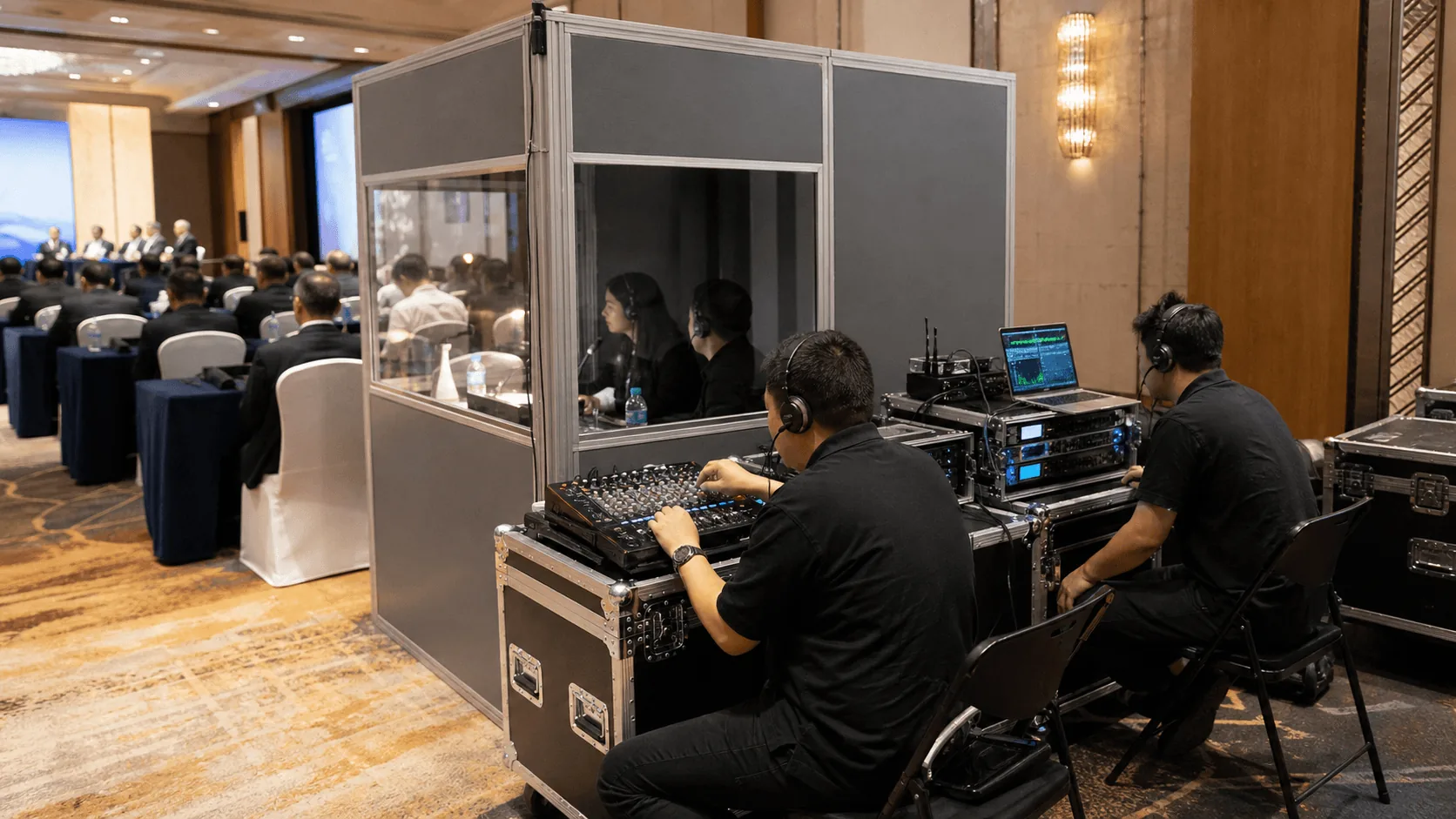
Live captions are not a substitute for interpreting
We never recommend replacing professional interpreting with real-time captions and expecting the audience to read them continuously throughout an entire multilingual conference. It is exhausting and significantly diminishes the attendee experience.
Furthermore, live captions in another language generally still depend on interpreting. If an event conducted primarily in English includes a brief contribution in Spanish, for example, the English captions would normally be produced from an English interpreting feed.
Imagine an eight-hour conference delivered entirely in Chinese when you do not understand the language. You would have to spend the whole day following English text that appears and is continually updated on screen, without understanding what you hear.
Would you really choose that option—especially when the text itself keeps changing—instead of listening to the conference naturally in English? Would you be able to stay focused and enjoy the presentations? The answer is obvious: no.
For extended multilingual communication, participants should normally be able to listen to professional interpreting in their own language, with live captions as additional support where appropriate, for example, to improve accessibility.
The exception to the rule
At events with thousands of attendees and only a short contribution in a foreign language, that feed may be provided solely to remote participants and the real-time captioner. Onsite attendees can then follow the English captions during that brief segment, avoiding the need to distribute receivers and headsets on such a large scale.
This can significantly simplify equipment logistics, but it still requires professional interpreting and does not give the audience the same experience as listening to the speaker in English.
One multilingual technical setup
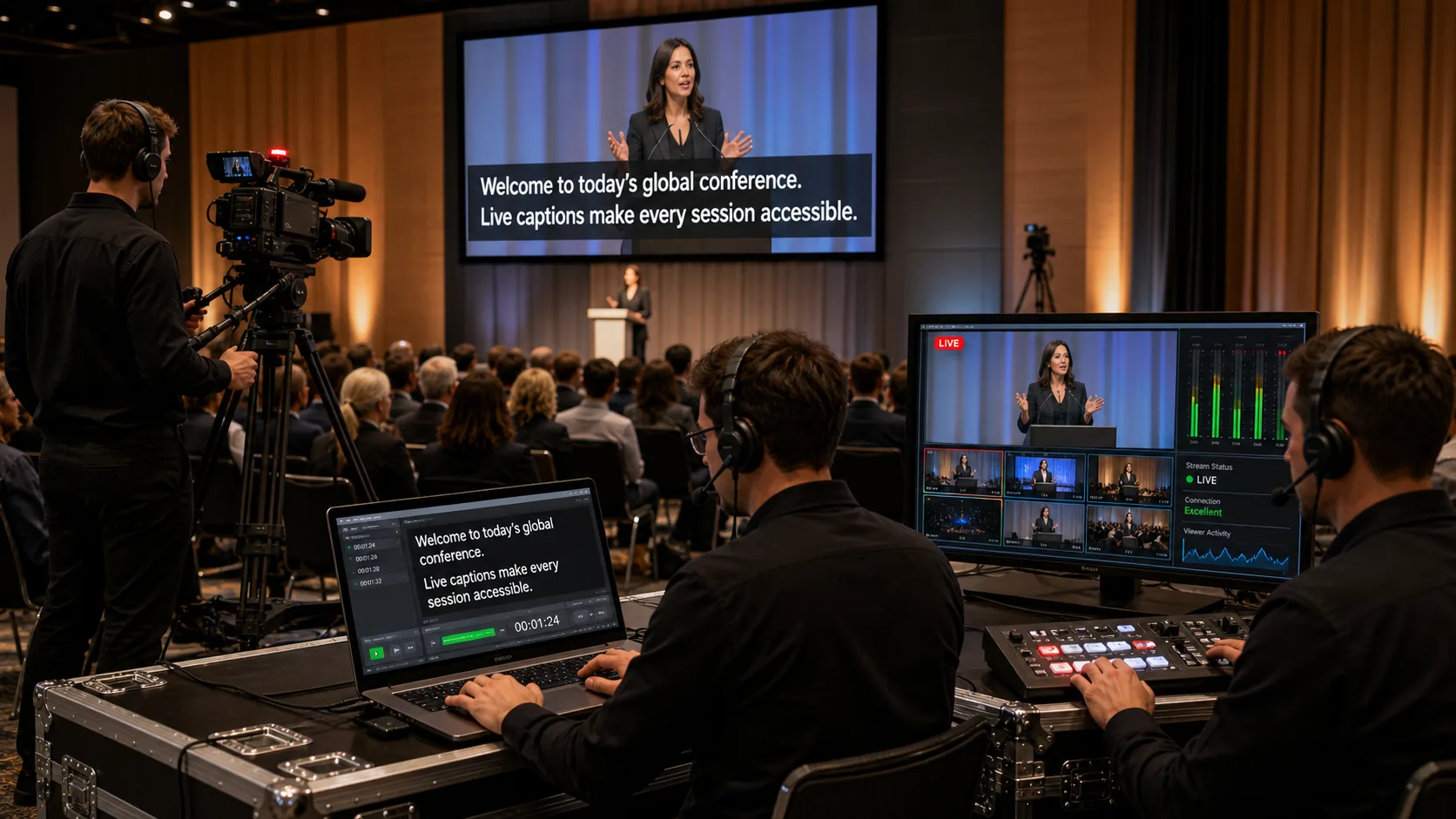 Live streaming, recording and captioning often interact with the interpreting infrastructure.
Depending on the event, we can therefore coordinate these services together with:
- simultaneous or consecutive interpreting;
- interpreting booths, consoles and headsets;
- remote simultaneous interpreting;
- hybrid-event integration;
- Zoom or other online platforms;
- remote speakers and participants;
- audiovisual and interpreting technicians;
- technical rehearsals and sound checks.
If you already have an AV company, venue technician, production agency or streaming provider, we can work directly with them and coordinate the requirements of the interpreting component.
You do not need to know exactly which technical solution you require.
Tell us about your event, the languages involved, where participants will be joining from and whether you need streaming, recording or live captioning, and we will help you define the appropriate setup.