Sad as much as we are of missing the outstanding interpreting event of the century (literally speaking!), “100 Years of Conference Interpreting”, in Geneve (3-4 October)?
We have a palliative solution! Below you can find the links to watch the videos of the entire event. Enjoy!
2. Keynote presentation on conference interpreter practice
Prof. Jesús Baigorri Jalón, University of Salamanca, Spain
3. Pecha Kucha presentations on on conference interpreter practice
Jonathan Downie & Graham Turner, Pedro Luis Queiros Duarte & Hugo Filipe dos Reis Cosme, Maya De Wit & Onno Crasborn, Anne Leahy, Maria Mikhailovskaia & Andrei Kalini, Carlo Eugeni & Rocio Bernabé Caro
4. Panel on conference interpreting practice
Prof. Jesus Baigorri Jalon, University of Salamanca, Spain Matthew Ball, Director, Translation Bureau, Canadian Government Juan Carlos Jiménez Marín, Director, DGLINC, European Parliament Uros Peterc, President, Int’lAssoc.of Conference Interpreters Moderator: Barry Slaughter Olsen, Professor, Middlebury Institute of International Studies at Monterey
CONFERENCE INTERPRETING RESEARCH
5. Keynote presentation on conference interpreter research
Prof. Alexis Hervais-Adelman, University of Zurich, Switzerland
6. Pecha Kucha presentations on conference interpreting research
Franz Pöchhacker & Monika Stögerer, Rhona Amos, Yanping Dong, Laura Keller, Laura Babcock & Silvia Fanton & Elisabet Tiselius & Fredrik Ullén, Eléonore Arbona, Yinghui Li & Yanping Dong, Xi Yun Yang, Camille Collard & Bart Defrancq, Koen Plevoets & Bart Defrancq
7. Panel on conference interpreting research
Prof. Alexis Hervais-Adelman, University of Zurich, Switzerland Bart Defrancq, Professor, University of Ghent, Belgium Ebru Diriker, Professor, Bogaziçi University, Turkey Franz Pöchhacker, Professor, University of Vienna Moderator: Kilian G. Seeber, Professor, FTI, University of Geneva
DAY 2:
CONFERENCE INTERPRETING TRAINING
1. Keynote presentation
Prof. Jacolyn Harmer, Middlebury Institute of Int’l Studies, USA
2. Pecha Kucha presentations on conference interpreter training
Marie Diur & Lucia Ruiz Rosendo, Helen Campbell, Carmen Maria Delgado Luchner & Nathalie Loiseau, Marcin Feder, Alicja Okoniewska, Conor Martin, Dirk Verbeke, Joshua Goldsmith Michelle Hof.
3. Panel on conference interpreter training
Prof. Jacolyn Harmer, Middlebury Institute of Int’l Studies, USA Javier Hernandez Saseta, Head, Multilingualism and Interpreter Training Support Unit, DGSCIC, European Commission Ian Newton, Senior Lecturer, FTI, University of GenevaClaudio Fantinuoli, Lecturer, University of Mainz Moderator: Monica Varela García, Chief, Interpretation Service, ILO
Christopher Thiery, Honorary President, AIIC Florika Fink-Hooijer, Director General, DGSCIC, European Commission Agnieszka Walter-Drop, Director General, DGLINC, European Parliament Marie Muttilainen, Director, Interpretation, European Courtof Justice Marie Diur, Chief Interpreter, UNOG Moderators: Jonathan Downie, Alexander Drechsel, Alexander Gansmeier (Troublesome Terps)
From left (badass polyglot) to right (bright & professional): Alessandra Vita, Francesca Manicardi, Alice Bertinotti, and Olga Jeczmyk.
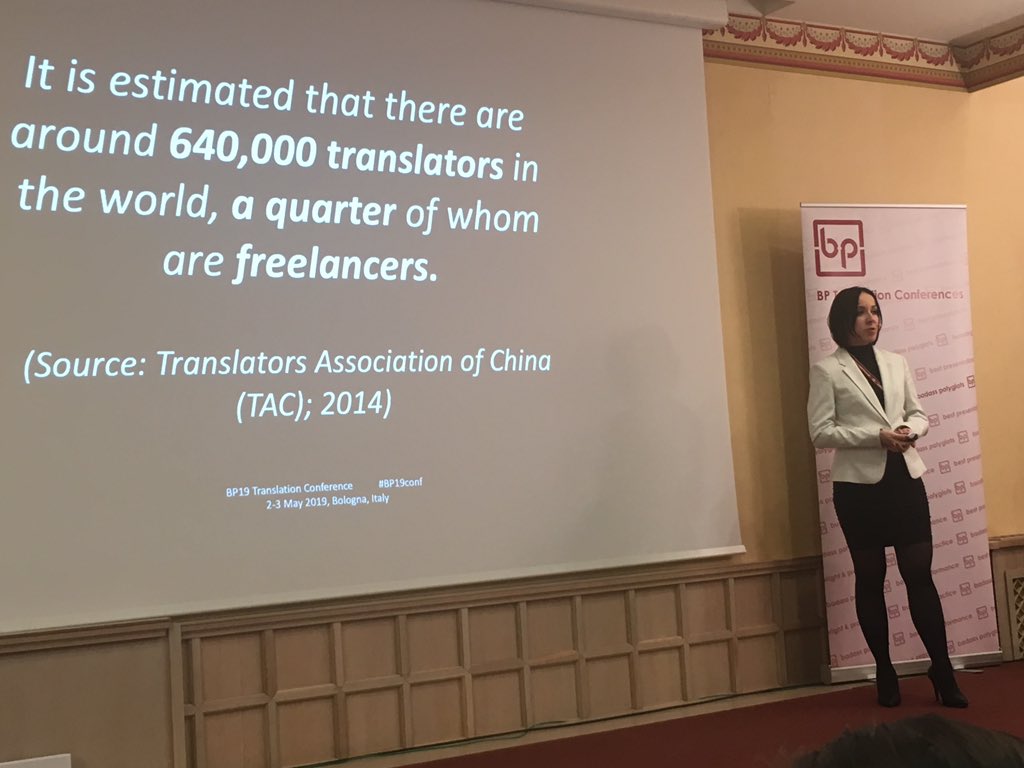
BP will probably sound familiar to you already if you are a translator or interpreter. It is a brilliant translation conference, organised on an annual basis by Csaba Bán since 2014: BP14 in Budapest, Hungary; BP15 in Zagreb, Croatia; BP16 in Prague, Czech Republic; BP17 again in Budapest; BP18 in Vienna, Austria. This year it was Bologna’s turn, in Italy, where the main conference was held on May 2nd and 3rd, preceded by several workshops on May 1st. It has been my first BP and surely not my last one.
What does BP stand for?
According to the BP story available on the website, BP stands for ‘business + practice’, even though it has been commonly associated with ‘badass polyglot’ and ‘bright & professional’, but also ‘birthday party’ (since this year the first conference day was Csaba’s birthday).
May 1st
On May 1st, the following four different workshops were offered. Unfortunately I only arrived in the evening for the welcome reception, so I cannot share my impressions.
May 2nd
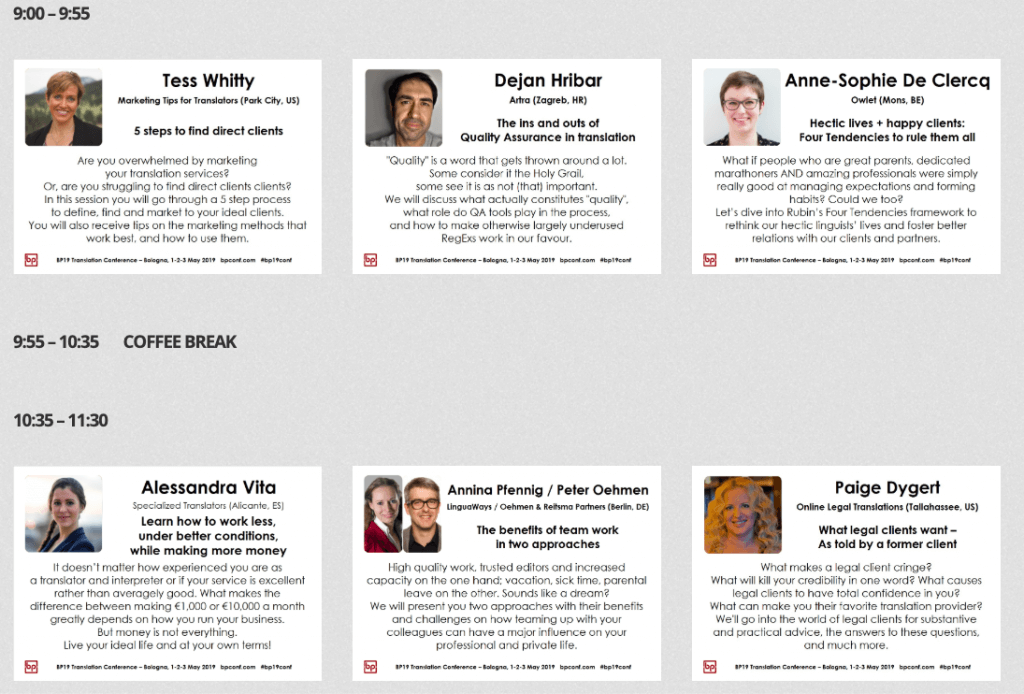
On May 2nd, speakers were divided in three tracks (always very hard to choose just one session) and gave one-hour-long talks.
My day started with Tess Whitty‘s session on how to find direct clients (here you can read the full thread on Twitter):
Tess Whitty, BP19
1) To find ideal direct clients, try to clone the ones you already have to get similar ones (only if you like the ones you have, otherwise skip the first step!).
2) Find where your ideal clients are and put yourself in their shoes.
3) Help them know EXACTLY what your brand is all about (e.g. use testimonials or surveys).
4) Decide on where to look for clients (e.g. go to industry events).
5) Pick 2-3 marketing methods that work for you (e.g. get published in clients’ journals; contact them on social media; send warm emails; call them; get a website, and also a LinkedIn account).
After listening to her podcast for ages when driving to interpreting assignments, it was great to finally meet her in person.
Alessandra, BP19. Picture credits: Carlos la Orden
Then I apparently didn’t have much choice but to attend my own talk, on practical strategies to try to work less, under better conditions, while making more money (the ideal goal of every freelancer, I guess).
Later I attended Alice Bertinotti‘s session on remote interpreting (here you can read the full thread on Twitter). Alice started talking about the history behind this phenomenon, with its first use in 1973 in Australia.
Alice Bertinotti, BP19
Then we moved to the related terminology: ‘distance interpreting’ can be with a direct view (‘teleconference interpreting’: ‘videoconference’ or ‘audioconference interpreting’) or without it (‘remote interpreting’: ‘video’ or ‘audio remote interpreting’).
After seeing the different possible setups, technical requirements and infrastructure, we saw its challenges (e.g. liability; obstacles to an effective communication; more stress and fatigue for interpreters compared to onsite assignments, even when good conditions are provided; etc.).
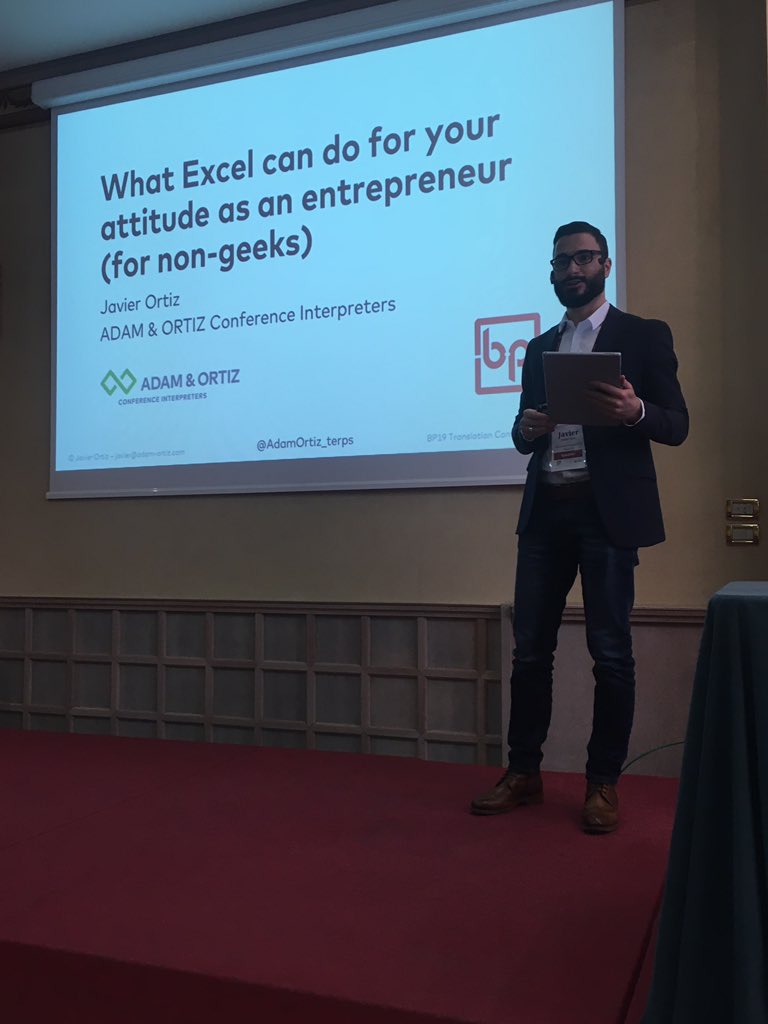
After very tasty tortellini for lunch, I found the Excel session by Javier Ortiz, a fellow interpreter, extremely interesting (here you can read the full thread on Twitter). I am an Excel-geek myself and love checking the cost-effectiveness behind each project, but Javier and his partner, Adam, use it at a whole other level!
Javier Ortiz, BP19
They track their working time with the app atWork to know exactly for which activity they’re using it, whether billable or not. With Excel formulas, among many aspects, they can see exactly how cost-effective a project is taking into account both billable and non-billable hours; where their income comes from exactly, and so on. I will surely implement some of what they are doing to gain more insights on my business.
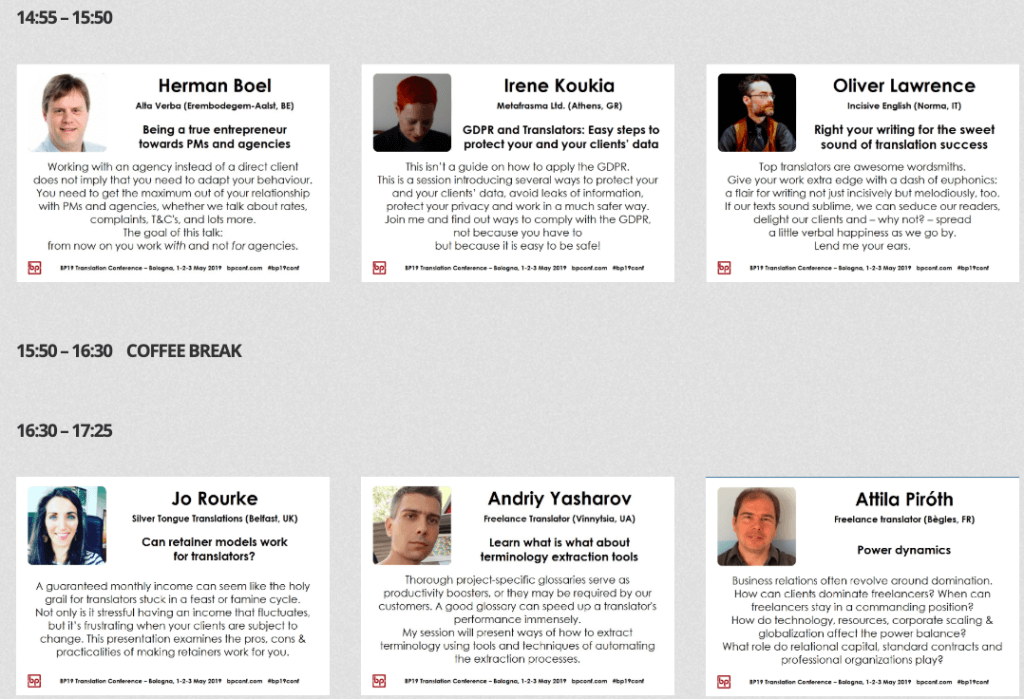
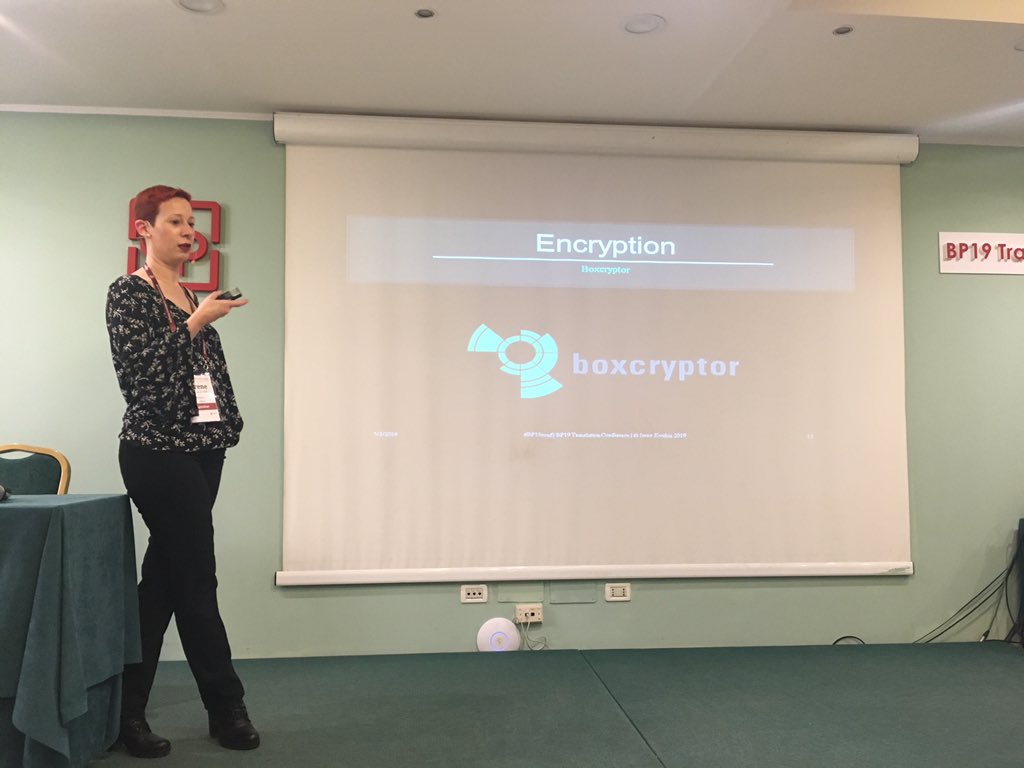
Irene Koukia talked then about how to backup and protect our data in a GDPR-compliant way. For example, she does a daily backup of her files on Dropbox or Google Drive, among others, and then she adds a second layer of GDPR-compliant encryption, for example with Boxcryptor.
Irene Koukia, BP19
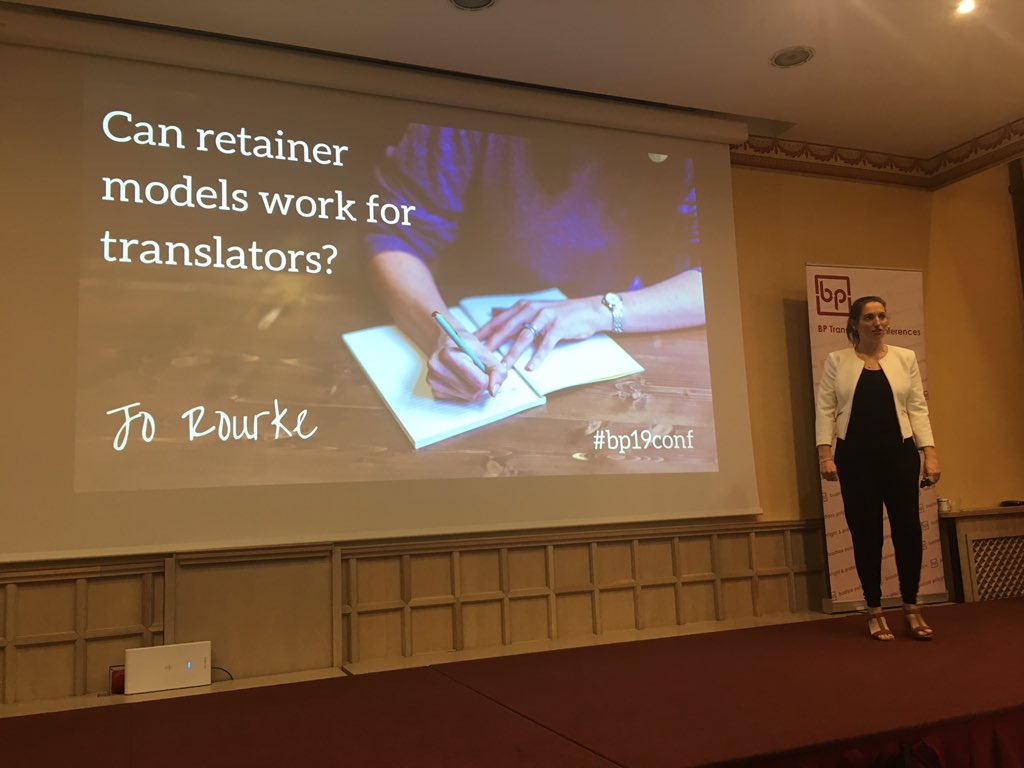
The final session of the day I attended was Jo Rourke‘s talk on retainers. She is indeed an amazing and extremely-funny speaker; plus, the topic was very far from usual, so the attention was constantly high (here you can find the full thread on Twitter).
Jo Rourke, BP19
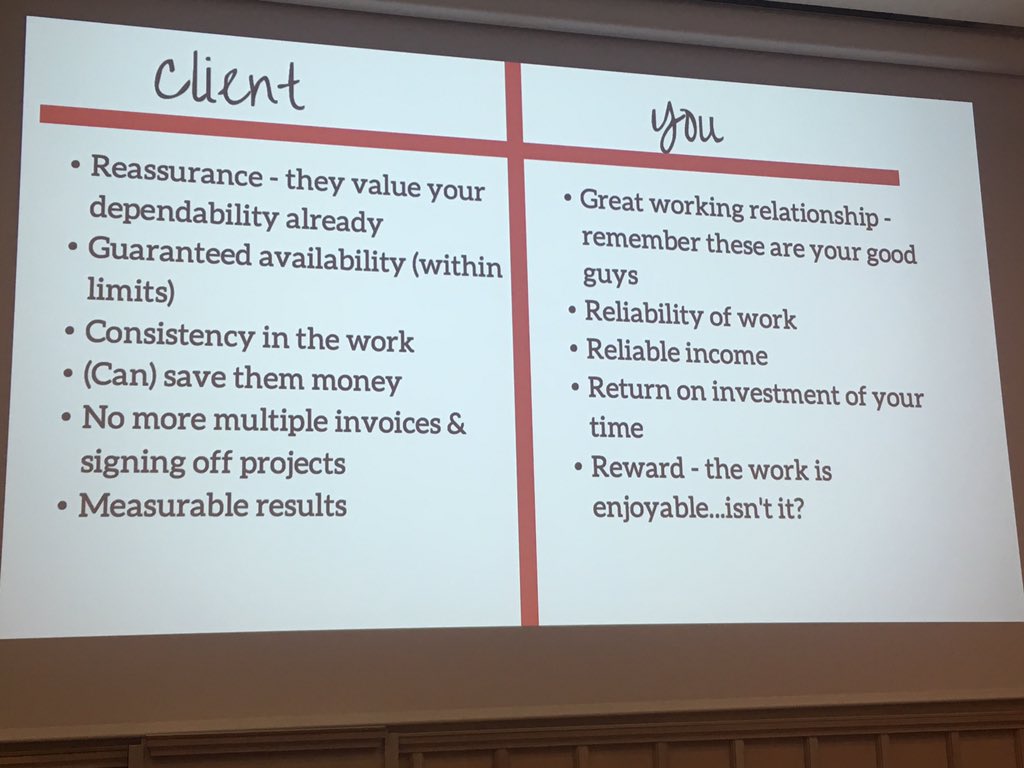
Retainers should only be used in certain situations, with only specific clients (the ones who pass her 4 Rs: Relationship, Reliability, Return on investment, and Reward), and only if it is a win-win situation for both her and the client, with the following benefits:
Only certain kind of work and documents can fit well with a retainer model. Furthermore, you should clarify very well beforehand the expectations, the scope of the work, the availability, etc. In any case, it is recommendable to start with a test period, and to go on with it only if the experience has been positive for both.
May 3rd
The last day was easier because we didn’t have tough choices to make. We were all grouped in a single room, in which all speakers gave 20-minute talks, moderated by the former-translator and funny comedian, Konstantin Kisin.
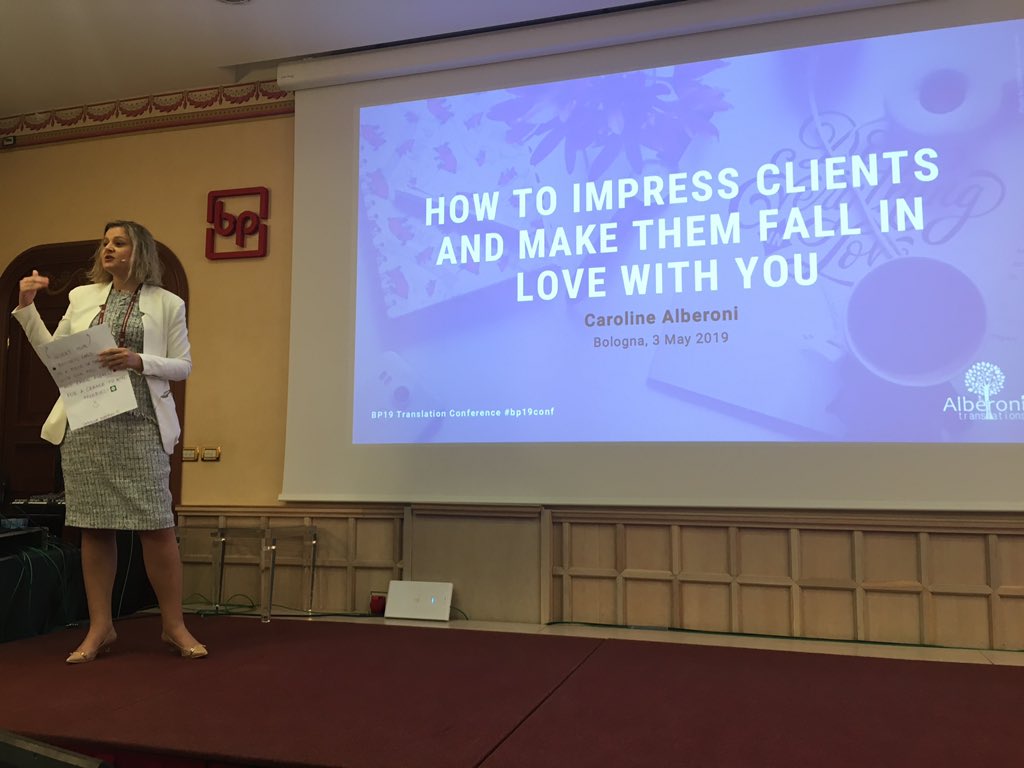
The day started with Caroline Alberoni on how to impress clients and make them fall in love with you (here you can read the full thread on Twitter). Caroline recommended that we should never leave our clients in the dark. We should inform them of future unavailabilities in advance and set OoO replies, as well as let them know of any issues during a project.
Caroline Alberoni, BP19
We should adapt to their needs and to their way of working, even when it is not ideal for us (e.g. receiving a translation as text in an e-mail, instead of a Word attachment). We should also mirror the tone clients use to speak to us. To stand out, we should go the extra mile: deliver earlier when possible; notify typos in the source; etc. Caroline reminded us that it all comes down to empathy and that a smile can do wonders. If we work like machines, we’ll be replaced by them.
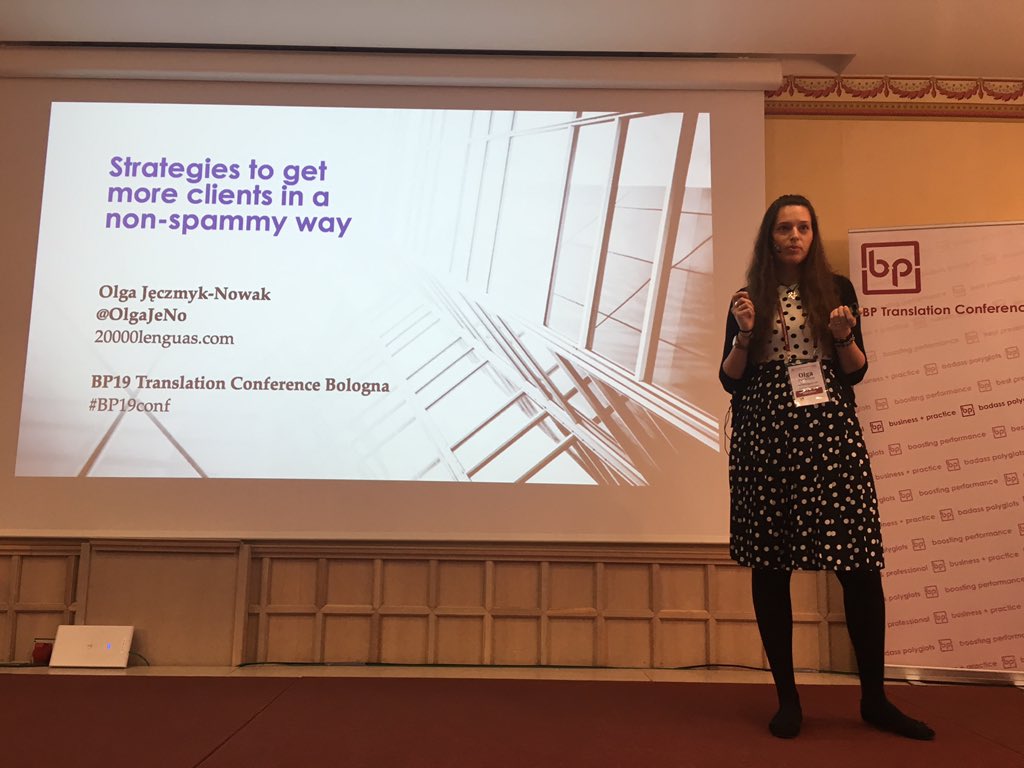
Olga Jeczmyk-Nowak spoke about how to get more clients in a non-spammy way (here you can read the full thread on Twitter). She recommended having a strong online visibility and studying about our clients to offer a customised solution and stand out from our competitors.
Olga Jeczmyk-Nowak, BP19
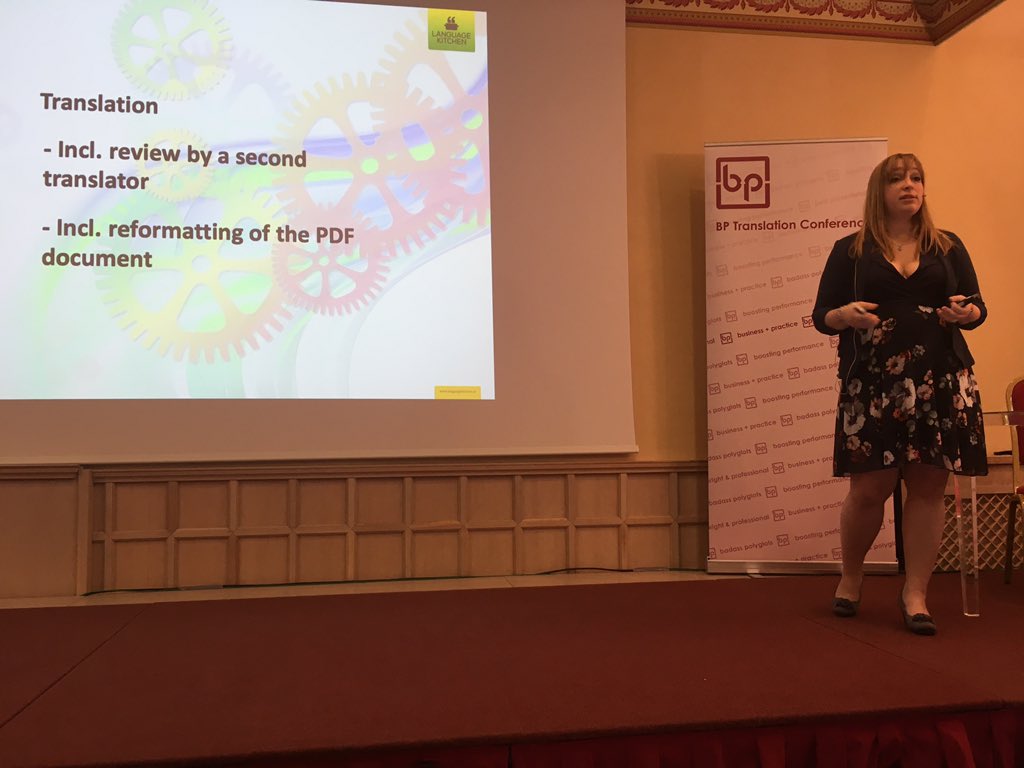
After Olga, it was the turn of Susanne Präsent-Winkler on how to raise our rates. She underlined that our prices are not equal to our income, since a big part ends up as taxes (according to her, we can also remind clients of this when they complain about our fees). A good tip she gave is listing in our quotes and invoices all the phases related to the job to make us stand out from the competition. Our service will look more comprehensive.
Susanne Präsent-Winkler, BP19
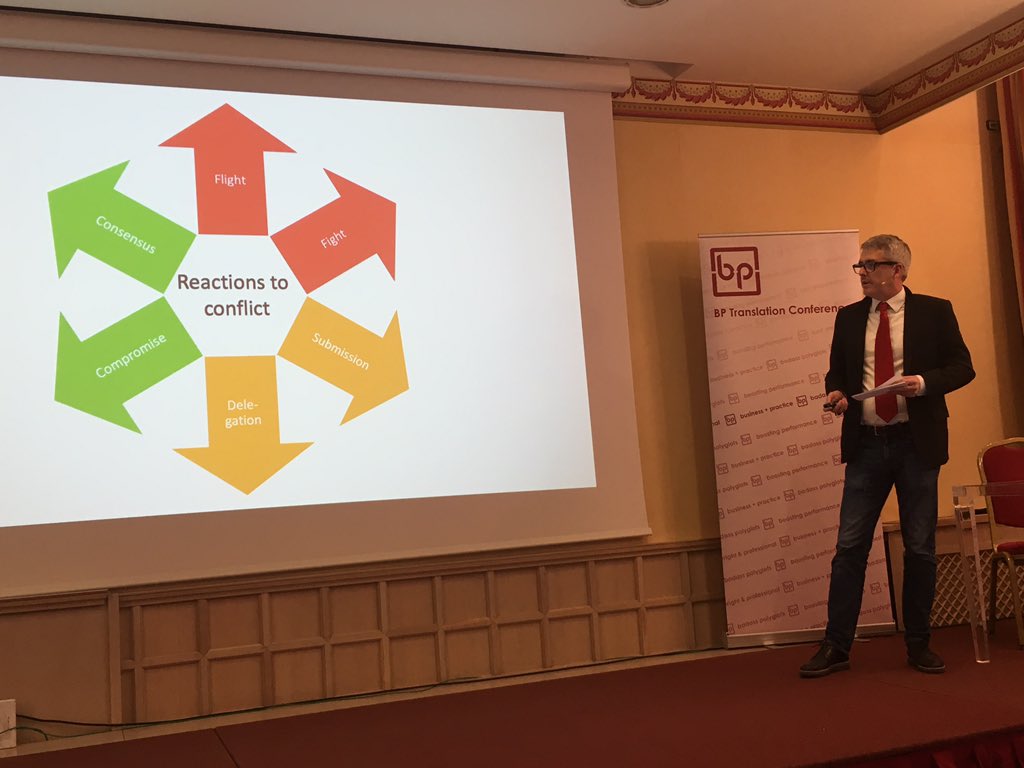
Peter Oehmen spoke about how to deal with difficult customers. Conflicts might be due to differences in perception, scarce or limited resources, unfair treatment, or independent work. There are different strategies to deal with conflicts, a good one being compromising and the ideal one being finding consensus.
Peter Oehmen, BP19
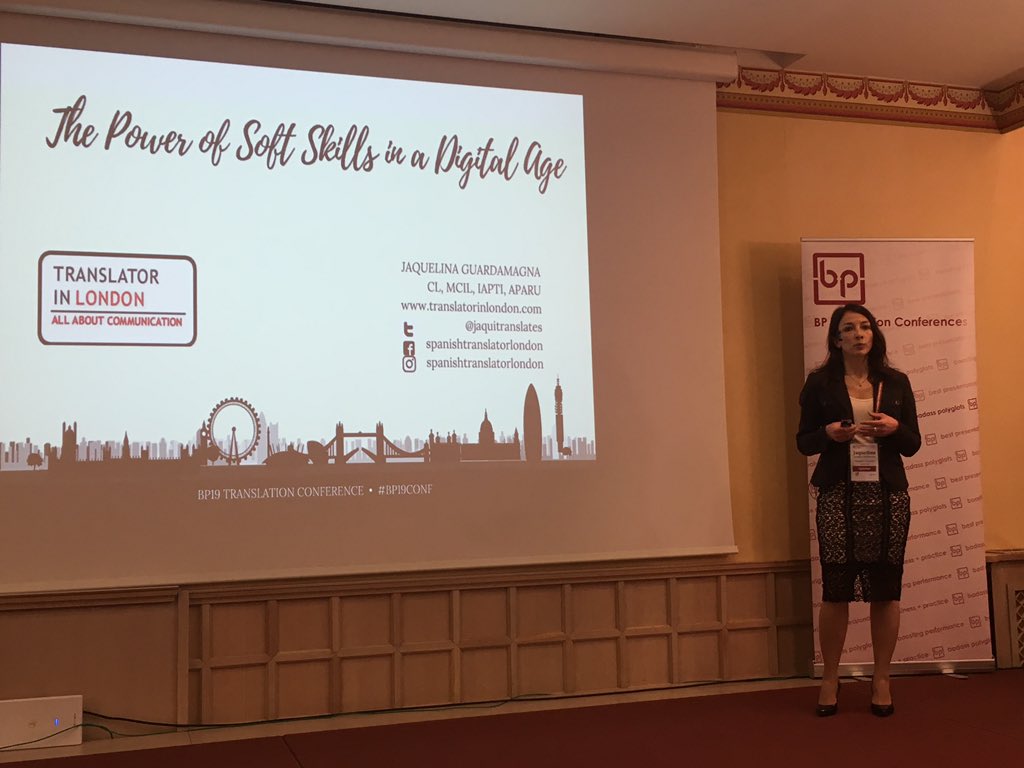
Jaquelina Guardamagna‘s session was on soft skills, which are a mixture of inter- and intra-personal skills, or “people skills” (here you can read the full thread on Twitter).
Jaquelina Guardamagna, BP19
She regards them as key for our business, and they can be used to soft sell, namely “a sales approach that features subtle language and a non-aggressive technique.”
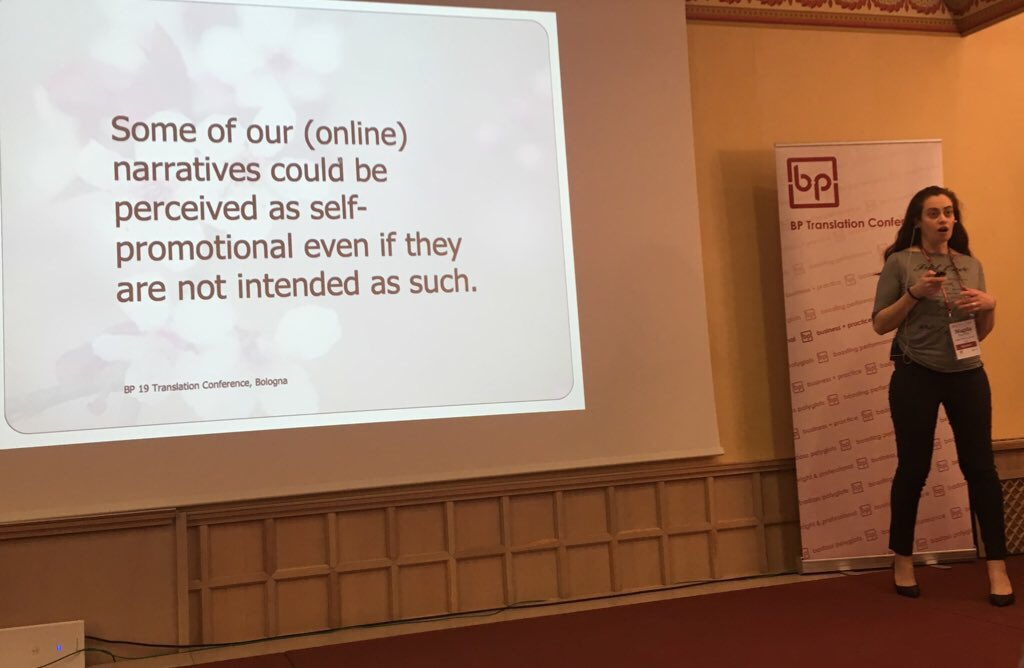
Magda Phili‘s topic was instead self-promotion. According to her, we should find the method that best works for us and that is compatible with our personality. She also underlined that humility, collaboration, and perseverance are the key ingredients to become a top-notch translator.
Magda Phili, BP19
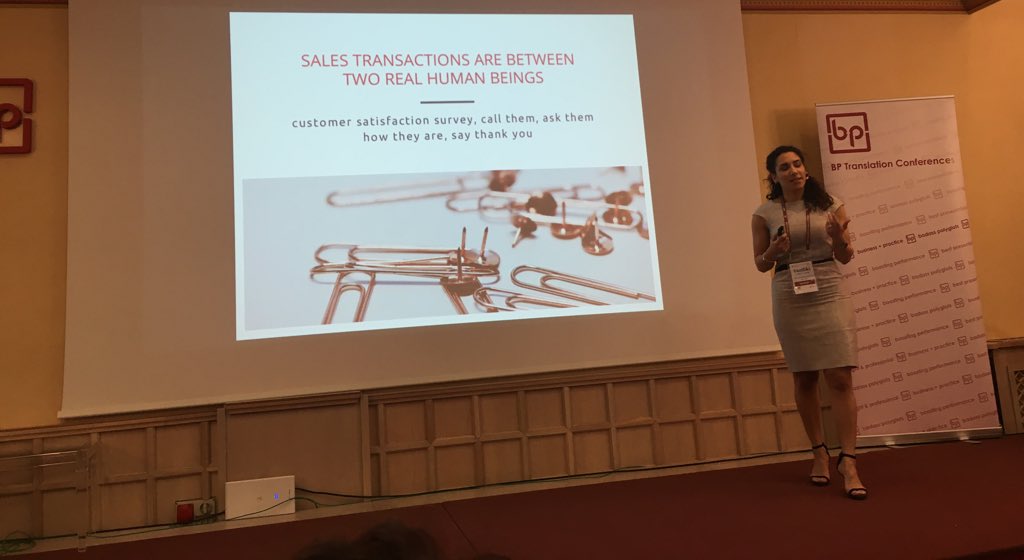
I truly loved Vasiliki Prestidge‘s storytelling session on professionalism, where she shared several fun anecdotes to make her point (here you can read the full thread on Twitter).
Vasiliki Prestidge, BP19
Our work clearly doesn’t end with an invoice. We have to make sure that our clients are satisfied and say thank you once in a while. We should treat all our clients with the same amount of professionalism (we never know who is our “golden package”, in reference to the Fedex ad). We are the most valuable asset of our business; so we should act as one.
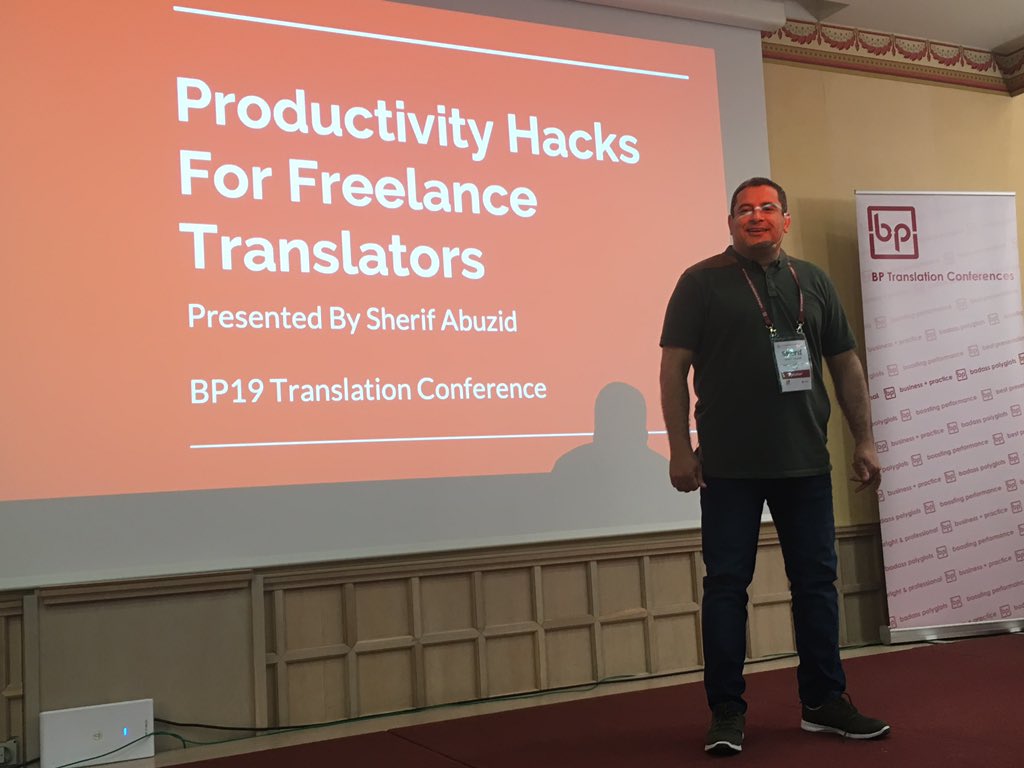
Sherif Abuzid shared with us some productivity hacks (here you can read the full thread on Twitter).
Sherif Abuzid, BP19
One is following the deep work principle, a “process of performing ‘professional activities… in a state of distraction-free concentration that pushes your cognitive capabilities to their limit…’”. In other words, he recommends mono-tasking to get in the flow. We can apply this principle by planning for tomorrow (only 5 minutes needed), focusing on goals rather than only on tasks, and setting tight deadlines for all activities. He underlined that it’s not the quantity of tasks we do that matters but rather if they are important for us and our business.
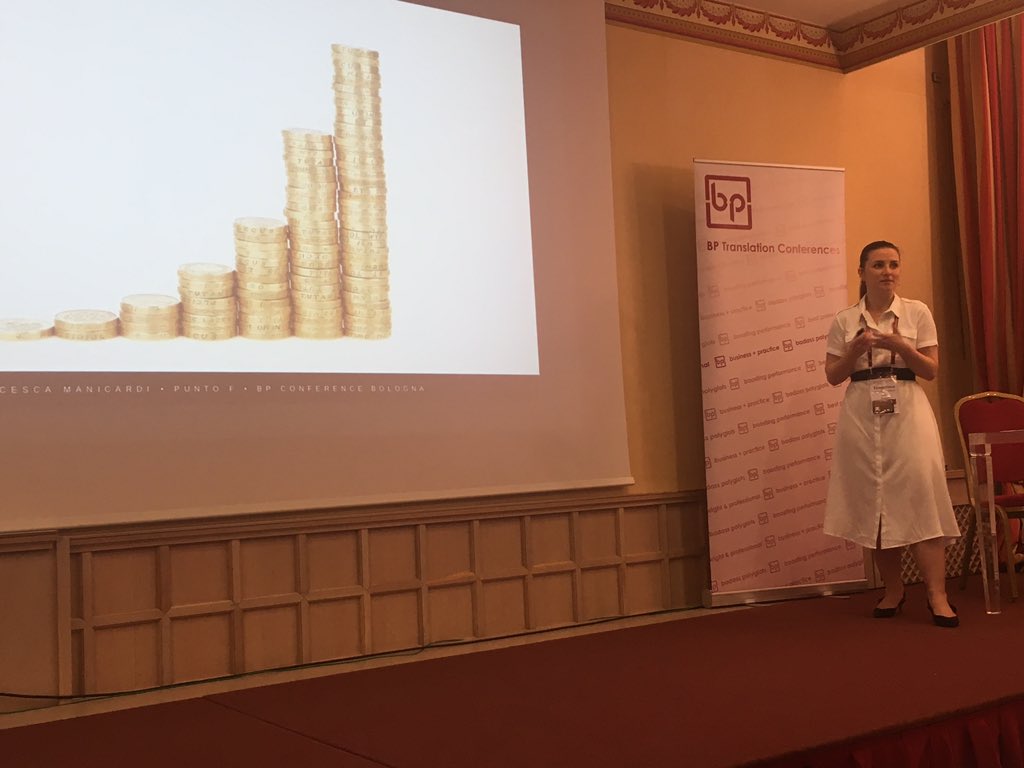
Francesca Manicardi mentioned the importance of diversification, listing some pros and cons of providing several services instead of only one or two.
Francesca Manicardi, BP19
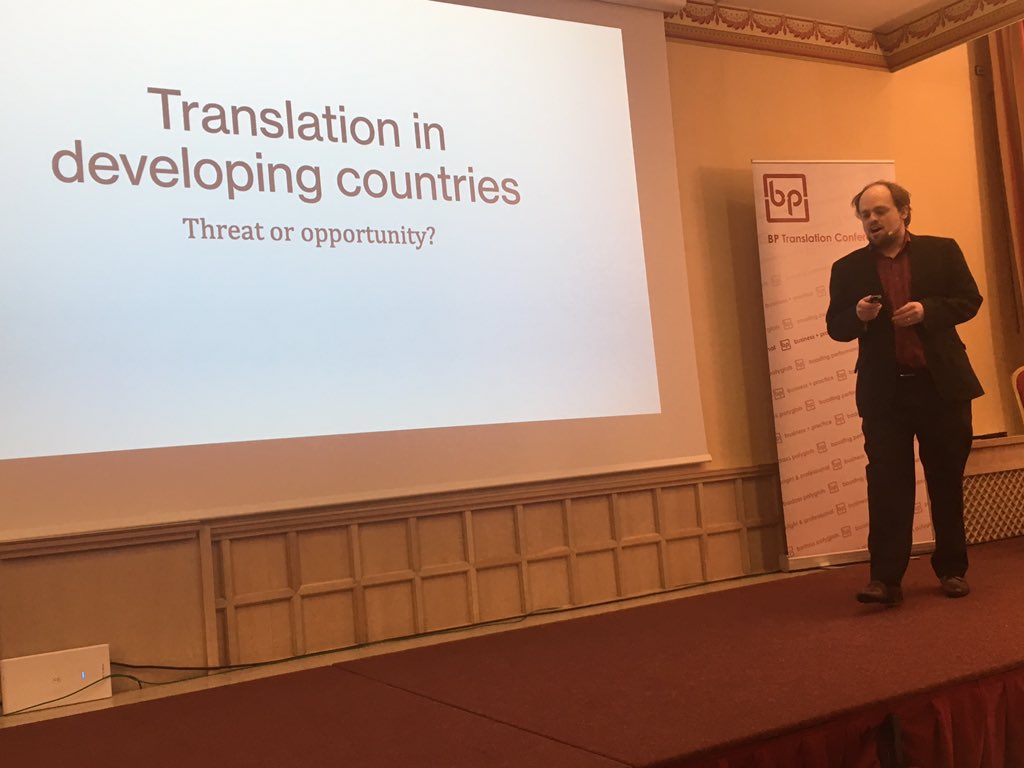
Timothy Barton‘s talk was about translation in developing countries, whether it is a threat or an opportunity. Since many of us are not familiar with certain markets, it was an interesting topic.
Timothy Barton, BP19
Iwona Piatkowska spoke about effective time management for translators (here you can read the full thread on Twitter). Work chunking is an effective strategy to be productive, and progress tracking has positive psychological effects. As a consequence, we should do 50-60% of the project as soon as possible, set a timer to see how productive we are, and avoid the unnecessary procrastination.
Iwona Piatkowska, BP19
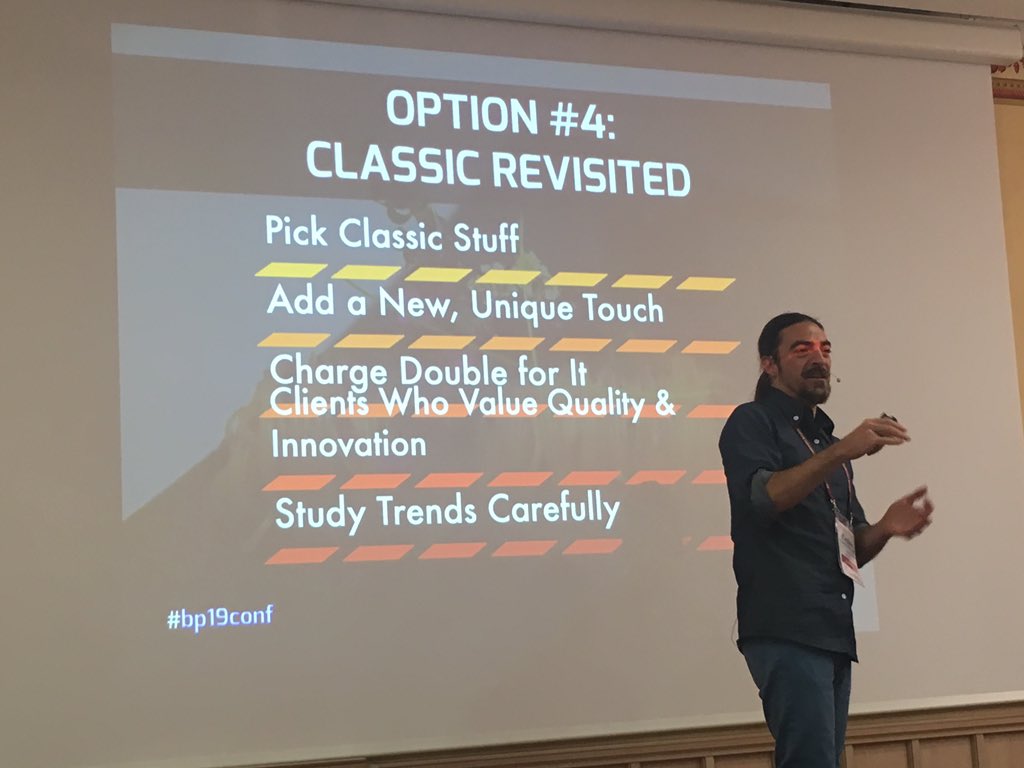
Carlos la Orden Tovar was a great closing speaker, who superbly mixed together many truths with a lot of humour in the same recipe (here you can see the full thread on Twitter). Like in the food industry, Carlos explained that we have different options when it comes to running our business, from untargeted and forgettable services to luxury and high-end solutions. An additional successful option he mentioned is his “classic revisited”, whose features you can find in the picture below.
Carlos la Orden Tovar, BP19
He underlined that it’s not all about the clients, but that it rather depends a lot on us when deciding how to run our business and what service we can offer. In order to deploy our killer strategy, he recommends: studying our ideal clients; engaging with them and finding them; listing our needs; planning buffer time, and considering proper training.
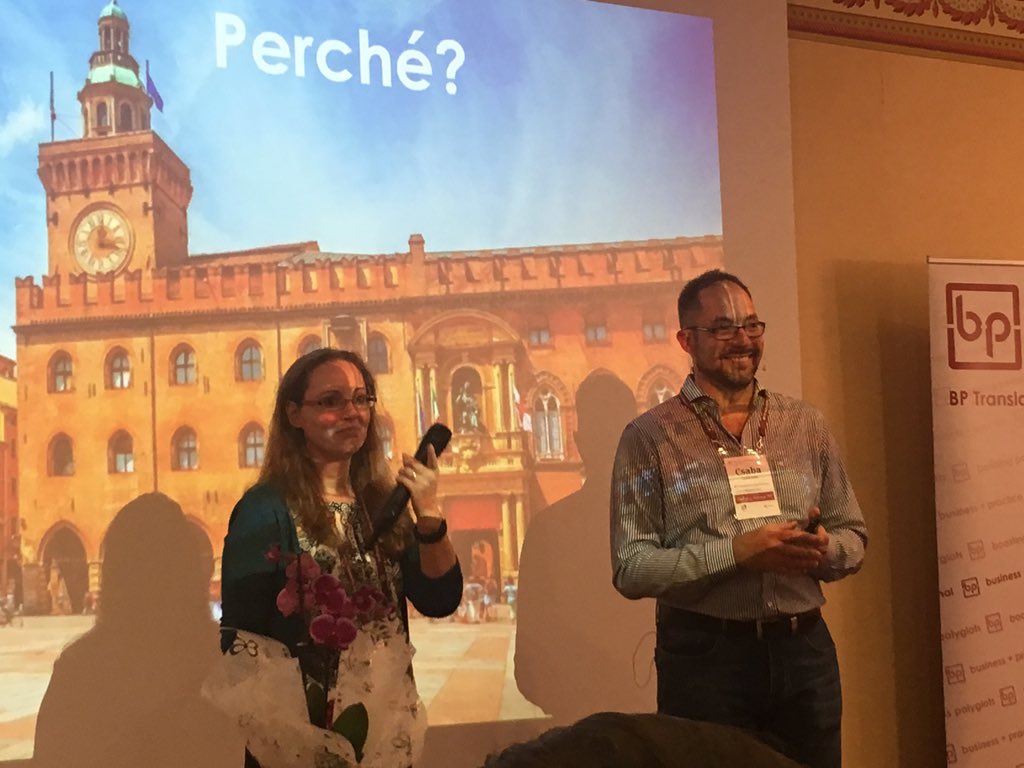
Csaba Bán, BP19 organiser
The conference ended with the words of its amazing organiser, Csaba, who explained the reasons behind choosing Bologna and announced that next year BP20 will be held in Nuremberg, Germany, on April 24th and 25th. I personally find incredible how he could take care of everything all on his own (with the help of his wife, but without a team of 100 people) and treated both attendees and us speakers so well, so thanks so much again for the wonderful experience.
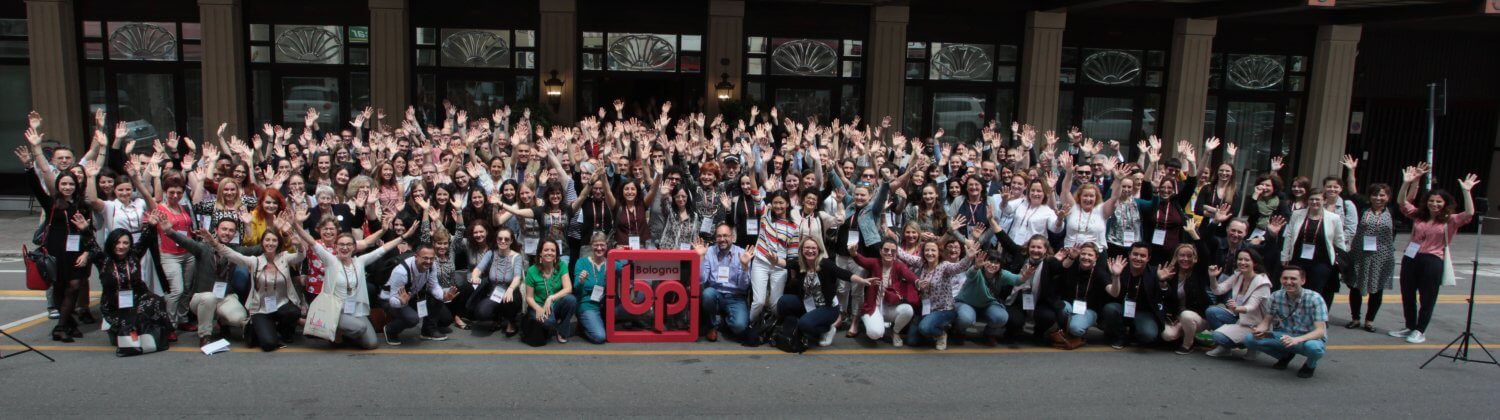
Official group picture of BP19 Bologna
P.S. This post will probably be updated as soon as the official pictures (far more decent than mine) and the announcement of the virtual conference will be made. Stay tuned and see you soon! 🙂
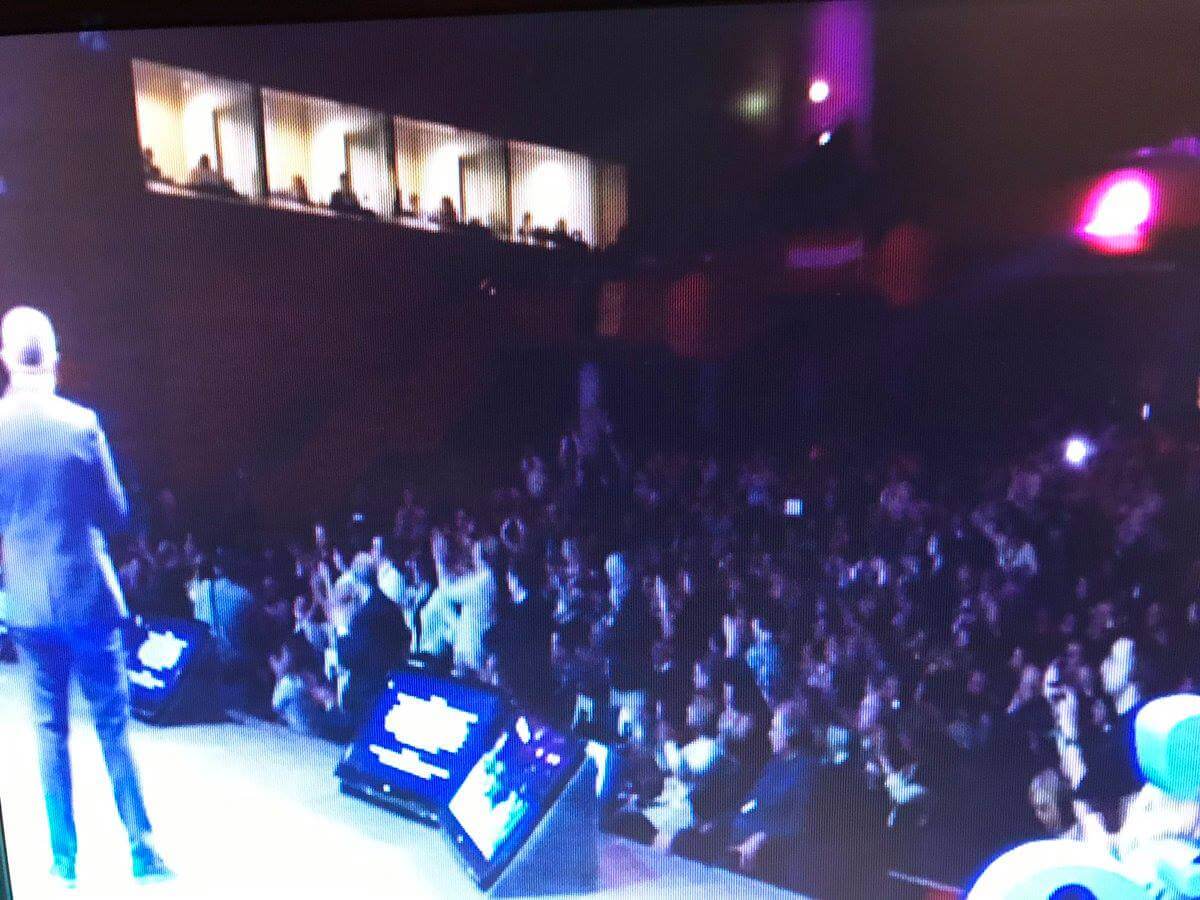
In the past few days we have been busy interpreting at the best multilingual conference ever. With attendees from all over the world and 12 amazing interpreters divided in six booths (English/Spanish, French, German, Italian, Portuguese, and Russian), this has been the best example of a multilingual conference we have seen so far.
Not even the EU is so multilingual: interpreters of all EU languages might be there ready to do their job, but unfortunately many speakers still decide to speak in English rather than in their mother tongue, leaving the English booth’s microphone off most of the time. In our opinion, this makes their message weaker, less assertive, with potential negative consequences on what they wanted to accomplish with it.
This case, instead, was simply amazing. Each and every person on stage spoke in their mother tongue, even when interacting with people of a different language. The event was taking place in two different auditoriums at the same venue, with more than 2,000 attendees in total.
Some sessions were held by two different hosts talking to each other, one in each auditorium. Most of the times, it was a Spanish-speaking host talking with an English-speaking colleague. This of course was piece of cake for us Spain-based interpreters, all with English and Spanish in our language combination, because each person of every booth could interpret alone this dialogue.
The most complex situation for us interpreters, though, was another session in which a French-speaking person was talking with his German-speaking colleague, again in the other auditorium. The only booth who had both languages covered was ours, the Italian booth, since I could interpret directly from German into Italian, whereas my colleague from French into Italian. We just had to be quicker than normal to keep about the same timing as the original dialogue, but it wasn’t complicated for us.
In the remaining five booths, though, our colleagues had to use what is called relay interpreting, i.e. using a colleague’s interpretation as the source message to be interpreted into their native language. For example, during this French-German session, our Russian colleagues (who had English, Spanish and Russian in their language combination) had to rely on the relay of both the German interpreter and the French one into Spanish, which they then rendered into Russian.
The tricky part is due to the delay. Even if it is called simultaneous interpreting, there is always a slight delay (in general, a couple of seconds) between us and the speaker, so that we have the time to process the information and offer it back in the target language. In this case the delay was double (from French/German to Spanish and then from Spanish to Russian); plus, the speakers were two with short parts each, which meant it all had to be very quick.
Again, the organisation of this event was superb. They provided in advance the scripts of the sessions and scheduled several rehearsals, where we could check whether we had enough time to do it with relay. As they say, practice makes perfect, and everything went great.
So the next time you organise a multilingual event, think about this great example, deliver your message as strongly as possible in your native language, and let us interpreters do the rest!
Imagine the following situations. A football-related press conference is about to start and foreign players will be interviewed. Would you trust a professional interpreter who hates football and couldn’t name more than five players in the world? Would you rather rely on a football fan who speaks more or less both languages but has no idea about interpreting and can just translate four words at a time?
What about an interpreter hired for the release of a new Star Wars film, who has never even watched the previous films?
If you were a doctor, would you trust a medical book translated by a professional translator who knows nothing about medicine?
The list can go on and on, but we probably have made our point already.
You don’t just need professionals, you need specialized translators and interpreters
First, knowing two languages is not enough to translate a text and interpret an event that is relevant to your business; you need a professional for it. Second, many times being a professional translator and interpreter might not be sufficient either; you need professionals that are also specialists in the field in question. This way, you can stay assured that they can truly understand the concepts, and speak the jargon of your target audience.
Specialization is our philosophy, our main differentiating factor, and something we don’t compromise on. We would rather not provide the service at all if we couldn’t keep this promise.
When I founded the company I had already embraced this philosophy long before. This is why as a freelancer I was already managing projects for my own clients thanks to a network of professional and trustworthy colleagues with different language combinations and fields of expertise. Specialized Translators was born just as a logical consequence providing this international network with a more formal structure.
There are many language service providers out there, we know. Choosing to rely on Specialized Translators will make you shine with your own clients and partners. You will show them that you care about them, and that you don’t compromise on quality either.











 In the past few days we have been busy interpreting at the best multilingual conference ever. With attendees from all over the world and 12 amazing interpreters divided in six booths (English/Spanish, French, German, Italian, Portuguese, and Russian), this has been the best example of a multilingual conference we have seen so far.